
Nyheter
This Month in Crypto: Monthly Insights from February 2023

Despite a regulatory crackdown on unregistered securities in the US, the total crypto markets remained headwind-resistant throughout February with a slight decline of nearly 2%. The resistance came primarily on the back of “Ordinals,” a Bitcoin-native protocol enabling minting NFTs on the Bitcoin blockchain for the first time, which boosted the network’s assets by 4.61% over the past month.
In addition, Ethereum’s testnet that simulated token withdrawals on February 7 increased ETH’s assets under management by ~9% over the past month as shown in Figure 1. The outperformers of last month’s rally were Optimism (21.34%) and Lido (41.56%); factors mainly driving these returns include Coinbase’s own scaling solution dubbed “Base” being built on Optimism and it was also known that Founder of Tron, Justin Sun staked 200K ETH via Lido, among other developments that we’ll delve deeper into later in this monthly review. February’s biggest loser was Avalanche, which declined by 15.10% on the back of a decline in daily activity on the network.
Figure 1: Price and TVL Development of Major Crypto Sectors
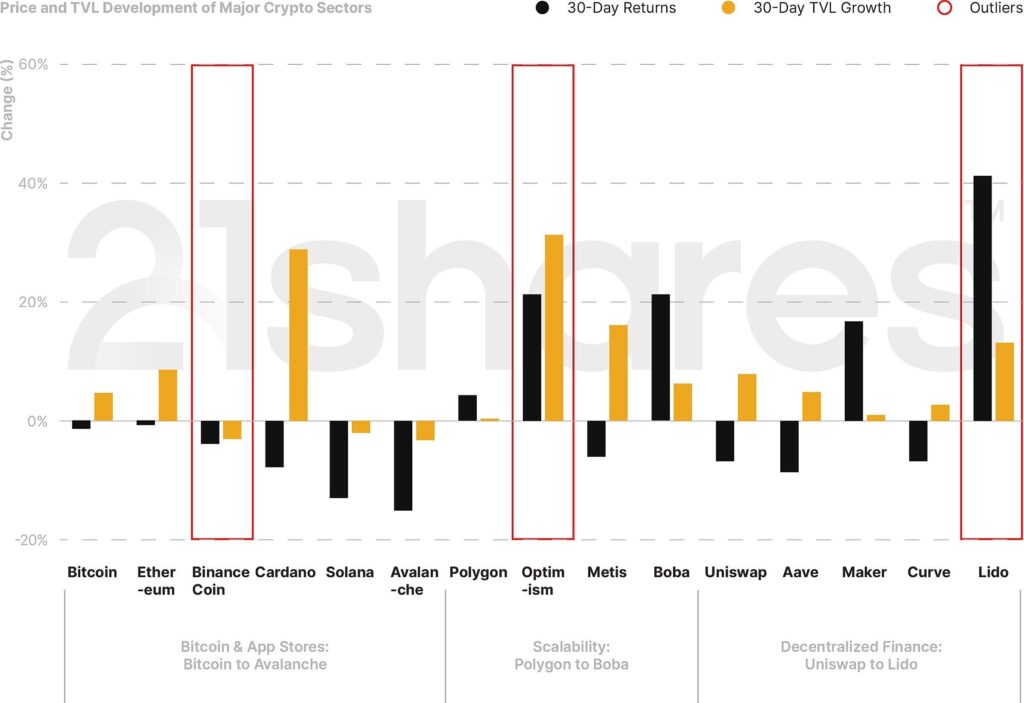
Source: 21Shares, Coingecko, DeFi Llama. Data as of February 27.
Key takeaways from this report
• The SEC cracks down on unregistered securities, halting the minting of Paxos’ BUSD on Binance among others.
• Ethereum executes two testnet upgrades prior to withdrawals.
• Coinbase launching Base, its own scaling solution on Ethereum
• Centrifuge suggests backing Aave’s GHO with RWAs, Siemens and Hamilton Lane issue a public bond and direct equity fund on Polygon, and Swarm introduces tokenized exposure to US treasury bills and stocks.
• An NFT protocol drives Bitcoin’s assets under management and broadens the use case of the original cryptoasset and Blur flips OpenSea in trading volume on the marketplace.
Spot and Derivatives Markets
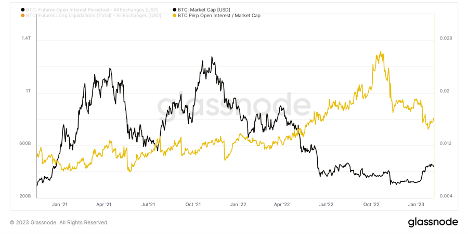
Figure 2: BTC Perpetual Swap Open Interest / Market Cap
Source: Glassnode
Figure 2 shows BTC perpetual swap open interest relative to Bitcoin’s market cap. We can see that the number of contracts built up relative to the market size increased significantly in 2022 until the FTX collapse. Since then, we have observed a general deleveraging of the system. However, over the month of February, the ratio has increased slightly as BTC’s price has consolidated, suggesting that risk appetite may be picking up among investors.
On-chain Indicators
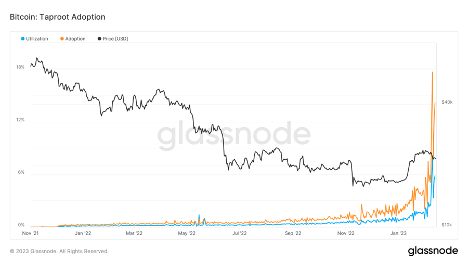
Figure 3: Bitcoin Taproot Adoption
Source: Glassnode
Figure 3 shows that Taproot adoption surpassed 5% for the first time on February 1 and reached 17.68% on February 9. The sudden rise in Taproot adoption is attributed to the launch of a project called Ordinals, which enables Bitcoin-native NFTs. Created by Casey Rodarmor, Ordinals embed image-related data into the Bitcoin blockchain using the input field in Taproot transactions. The Taproot upgrade, activated in November 2021, makes it cheaper to store arbitrary data and allows users to store as much data as they like in a single transaction, as long as they pay for it and the total block size remains under 4MB. Before Taproot, one had to use multiple transactions or inputs to store large amounts of data.
The introduction of NFTs on Bitcoin can expand its use cases beyond a store of value asset. The latter would increase fees, which would be a net positive for the long-term security of the network, especially as the emission of new BTC will end in 2140.
Next Month’s Calendar

Source: 21shares, Forex Factory
Read full report here
Research Newsletter
Each week the 21Shares Research team will publish our data-driven insights into the crypto asset world through this newsletter. Please direct any comments, questions, and words of feedback to research@21shares.com
Disclaimer
The information provided does not constitute a prospectus or other offering material and does not contain or constitute an offer to sell or a solicitation of any offer to buy securities in any jurisdiction. Some of the information published herein may contain forward-looking statements. Readers are cautioned that any such forward-looking statements are not guarantees of future performance and involve risks and uncertainties and that actual results may differ materially from those in the forward-looking statements as a result of various factors. The information contained herein may not be considered as economic, legal, tax or other advice and users are cautioned to base investment decisions or other decisions solely on the content hereof.















JGPD ETF är en aktivt förvaltad ETF som delar ut månadsvis

JP Morgan noterar tre nya ETFer på Xetra en av dem i SEK

OSYU ETF ger exponering mot Secured Overnight Financing Rate

iShares Space Technologies UCITS ETF investera bortom jorden

JIPD ETF delar ut månadsvis

USA satsar 2 miljarder dollar på kvantdatorer – så kan investerare dra nytta av utvecklingen

De bästa ETFerna för att investera i emerging markets

Extrema skillnader: Varför presterar Europas kvantdator-ETFer så olika?

Fastställd utdelning i MONTDIV maj 2026

Varför Plus500 är en dröm för finans-affiliate
-
 Nyheter3 veckor sedan
USA satsar 2 miljarder dollar på kvantdatorer – så kan investerare dra nytta av utvecklingen
-
 Nyheter4 veckor sedan
De bästa ETFerna för att investera i emerging markets
-
 Nyheter2 veckor sedan
Extrema skillnader: Varför presterar Europas kvantdator-ETFer så olika?
-
 Nyheter3 veckor sedan
Fastställd utdelning i MONTDIV maj 2026
-
 Nyheter2 veckor sedan
Varför Plus500 är en dröm för finans-affiliate
-

 Nyheter4 veckor sedan
ASWF ETF är en aktivt förvaltad fond som investerar i Kanada
-

 Nyheter2 veckor sedan
QQCC ETF följer företag världen över som är aktiva inom kvantberäkning
-

 Nyheter2 veckor sedan
ETFer för fotbolls-VM 2026
