
Nyheter
As Competition Rallies Up, What is the Future of Crypto Infrastructure?

Inflation in the U.S. accelerated 3.7% higher than last year in August, mainly due to a surge in oil prices to a 10-month high. However, the biggest cryptoassets by market cap bounced back over the past week; Bitcoin and Ethereum rose by 6.4% and 5.6%, respectively. This surge in returns and total value locked (TVL) is mainly due to the emergence of new Bitcoin spot ETF applications in the U.S., all pending approval. As shown in Figure 1, the biggest winner among settlement layers was Solana, increasing by 10.9% week-over-week. While within the scalability solution, the positive outlier was Arbitrum, increasing by 8.18% over the past week. Aave saw the highest returns across the board, increasing by 16.3% week-over-week.
Figure 1: Weekly Price and TVL Developments of Cryptoassets in Major Sectors
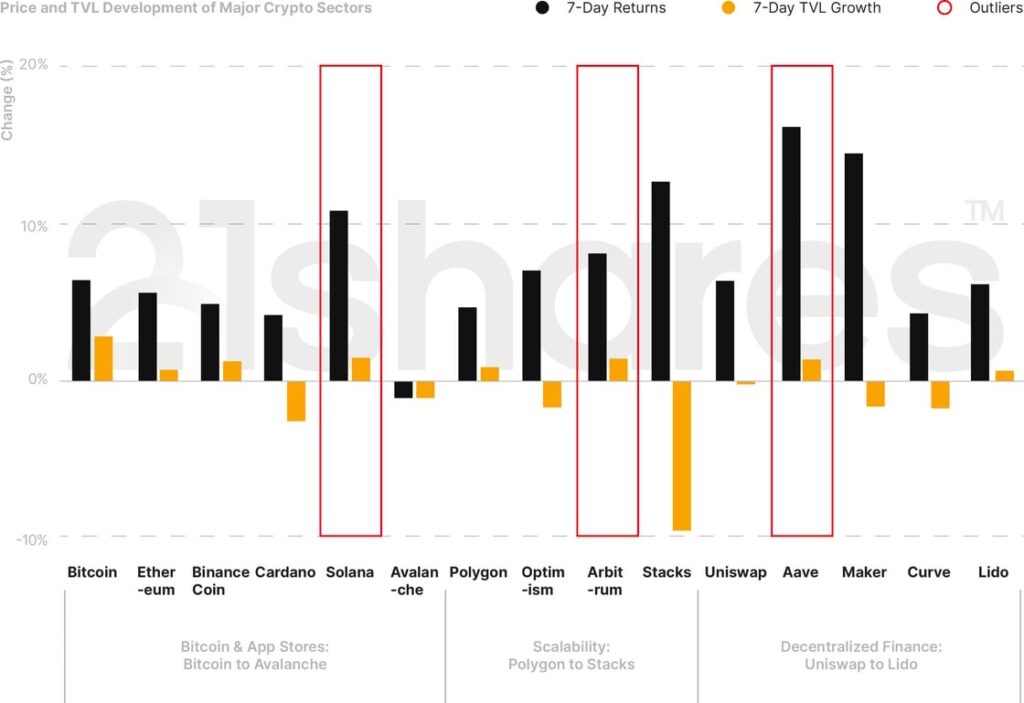
Source: 21Shares, CoinGecko, DeFi Llama. Close data as of September 18, 2023.
5 Things to Remember in Markets this Week
• The Road to POL
Polygon Labs introduced its first three improvement proposals in preparation for their migration to an ecosystem with “unlimited scalability and unified liquidity.” In Phase 0, announced on September 14, the company will first initiate the upgrade from MATIC to POL, which will become the native (gas) and staking token for the proof-of-stake version of Polygon. Finally, they’ll launch the Staking Layer, enabling validators to secure many chains in Polygon’s new ecosystem. Although end-users won’t be affected at this stage, Polygon’s move aims to expand Ethereum’s blockspace to be more analogous to a mesh network topology like the internet. With ZK technology, Ethereum blockspace can scale to the size of the Internet for the first time in blockchain history. Once the community endorses these proposals, implementation will begin as early as Q4 of this year.
• Competition Intensifies Between Layer 2 Ecosystems
Astar Network – a Polkadot parachain and one of Japan’s leading smart contract platforms – announced ”Astar zkEVM,” an upcoming Ethereum L2 built using the Polygon CDP. For context, Polygon CDP is an open-source codebase for launching zero-knowledge L2 chains for Ethereum. The modular scaling thesis is playing out before our eyes as L2s converge upon similar blockchain architectures, launching their custom development kits to allow teams to deploy their own chains easily. Arbitrum has ”Orbit,” zkSync released the ”ZK Stack,” and Optimism has the ”OP Stack,” upon which Coinbase launched its L2 network Base in August. While it’s still unclear which standard will accumulate the most network effects, the fierce competition between L2s is unequivocally positive for Ethereum, which may see an influx of new developers, applications, and users. Moreover, L2s must pay transaction fees in ETH when posting transaction data on Ethereum, generating demand for the asset and increasing the network’s economic sustainability.
Figure 2: Layer 2 TVL Market Share
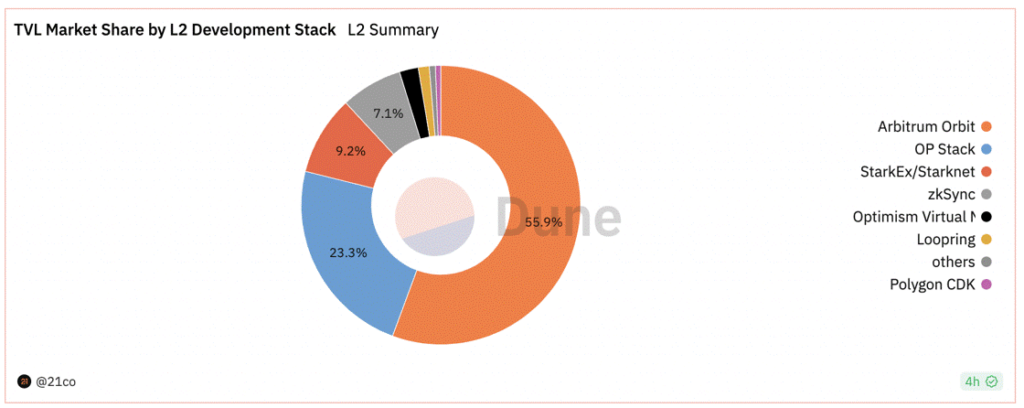
Source: 21co on Dune Analytics
• Google Cloud Competes with Crypto-Native Oracles
In the past few months, we’ve seen a rise in Web2 companies leveraging their time-tested technologies to help strengthen the infrastructure of decentralized protocols. The newest addition to this trend is Google Cloud becoming the default oracle configuration on LayerZero (valued at $3B), a messaging protocol between blockchains offering on-chain assurances facilitated by off-chain entities, which include oracles and relayers. LayerZero had initially integrated with Chainlink and TSS; while the 34-so-far dApps using LayerZero will still have the option to use these oracles, Google Cloud poses a threat to its decentralized counterparts. So far, Google Cloud provides oracles for BNB Chain and Tezos, among others. Crypto-native oracles will have to improve their user interfaces, and pricing schemes, along with their due diligence on the real-world data they bring on-chain to address the competition.
• MetaMask’s Snaps
MetaMask launched its Snaps Open Beta, allowing users to customize their wallet by adding community-built features, similar to how users can customize their smartphone experience by installing various applications from the app store. Built by independent developers, Snaps represents the first step toward MetaMask’s ”permissionless innovation” strategy, enabling anyone to extend the wallet’s functionality. This move validates our thesis that wallets are to crypto what browsers were for the Internet – how users will interact with applications and immerse in digital experiences. An interesting use case of Snaps is turning MetaMask into a cross-chain wallet by integrating with ShapeShift and THORChain on the backend. However, users should be wary of what they install on their wallets. Because anyone can contribute, some Snaps may contain bugs or malicious software, potentially compromising user funds.
• The LSM Launches on the Cosmos Hub
The Liquid Staking Module (LSM) launched on the Cosmos Hub last week, initiating a safe way to increase capital efficiency on the network. The LSM is a regulation framework for liquid staking providers that aims to mitigate risks by limiting the total supply of ATOM that can be liquid staked to 25%. Lowering the cap to 25% prevents providers from controlling >33% of the stake, a crucial threshold for malicious actors to halt block production or censor transactions. The LSM also enables users to instantly liquid-stake their staked ATOM without having to wait for the 21-day unbonding period. The LSM is a novel approach to the liquid staking protocol design space. On Ethereum, Lido has a ~32% market share of all staked ETH, and many prominent network contributors like Vitalik Buterin or Danny Ryan have voiced their concerns, calling for a self-limit on Lido’s growth. Ideologically, setting a cap on liquid staking providers makes sense to increase censorship resistance and promote decentralization. However, there is no guarantee that imposing artificial limits will end well in practice. If it were not for Lido, most staked ETH would have concentrated in a handful of centralized exchanges.
Figure 3: Market Dominance – Staking Entities
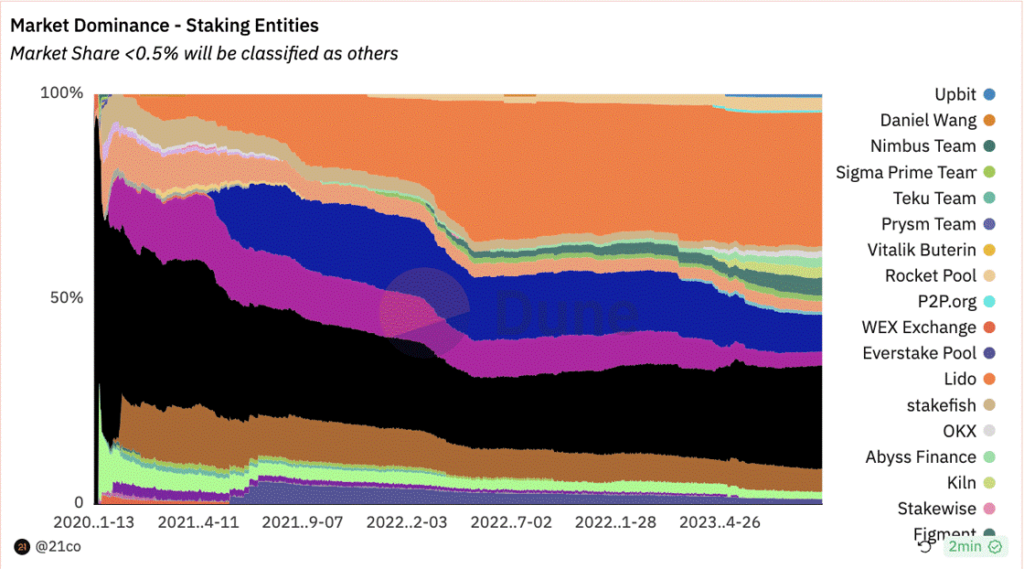
Source: 21co on Dune Analytics
What You Should Pay Attention To
Ethereum’s Goerli Testnet to Be Replaced with Holesky
Holesky is the first testnet to be tailored for Ethereum’s proof-of-stake consensus. The upcoming testnet promises to have 1.46 million validators, almost twice as much as the mainnet’s, so that testing the limits of the Beacon Chain (for ETH stakers) is done safely. Moreover, Holesky aims to address other scalability issues in its predecessor, Goerli. The shortage of goETH testnet tokens was a nuisance for developers using Goerli. Ethereum’s core developers will ensure the supply of testnet ETH is abundant, allocating 10x the mainnet’s supply at launch, 1.6B HETH for developers.
The testnet was scheduled to launch on Friday to commemorate the Merge’s first anniversary. Due to a misconfiguration in one of the genesis files of the network, Holesky failed to launch, marking a disappointing milestone for Ethereum. The core developers will regroup to find a fix and launch the new testnet in a week or two.
New York Regulator Proposes Higher Standards for Coin-Listings and Delistings
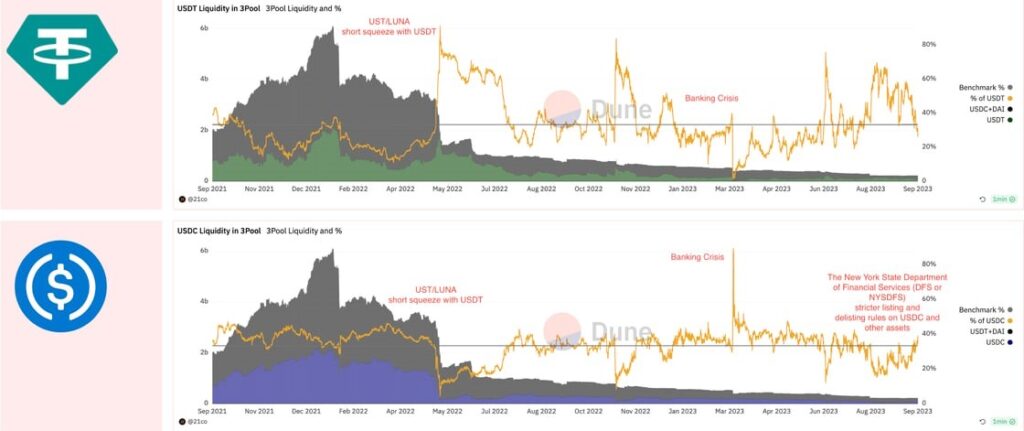
On Monday, the New York State Department of Financial Services (DFS) published guidance to the crypto industry, exempting all virtual currency business entities (licensed under 23 NYCRR Part 200 or chartered as limited purpose trust companies under the New York Banking Law) from prior approval to list coins included on the Greenlist. However, they must notify the DFS 10 days before listing Greenlisted cryptoassets and have a DFS-approved coin-delisting policy.
The Greenlist currently covers Bitcoin, Ethereum, and six more cryptoassets pegged to real-world assets like the USD, JPY, and gold – excluding the two most dominant stablecoins by circulation and market cap, USDT and USDC. Governed by the DFS, the regulator can consider adding cryptoassets given that:
• The coin or coin issuer has a demonstrated, historic record consistent with safety and soundness and the protection of customers, including broad marketplace adoption or
• The coin is a stablecoin approved by DFS for issuance in New York by a VC entity
The proposal, published on September 18, is open for public comment until October 20. In the figure below, our Dune Dashboards show how stablecoin markets reacted on Curve’s 3Pool.
Figure 4: Comparison between USDT and USDC Liquidity Pool
Source: 21co on Dune Analytics
Next Week’s Calendar
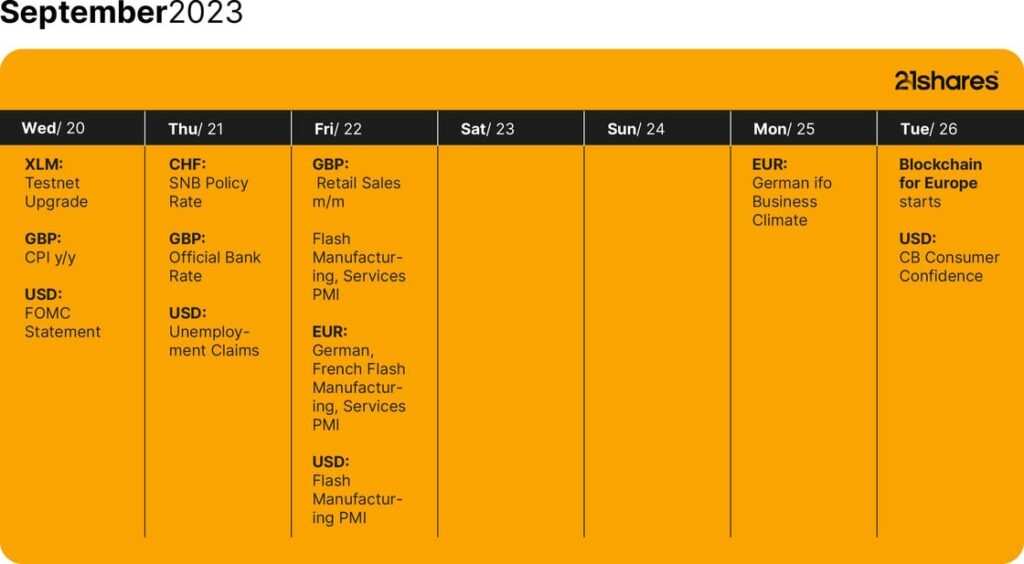
These are the top events we’re monitoring for next week.
• FOMC Statement: the Federal Reserve will announce to investors their vote-based decision on the state of this month’s interest rate.
• Germany’s Information and Forschung: measures the level of a composite index based on 9K surveyed manufacturers, builders, wholesalers, services, and retailers. Thus, it’s a leading indicator of Germany’s economic health and the wider Eurozone. For the past four months, the index has been deteriorating.
• Blockchain for Europe is one of Europe’s leading industry-wide summits discussing primarily crypto policy in Brussels.
Source: Forex Factory, CoinMarketCal
Research Newsletter
Each week the 21Shares Research team will publish our data-driven insights into the crypto asset world through this newsletter. Please direct any comments, questions, and words of feedback to research@21shares.com
Disclaimer
The information provided does not constitute a prospectus or other offering material and does not contain or constitute an offer to sell or a solicitation of any offer to buy securities in any jurisdiction. Some of the information published herein may contain forward-looking statements. Readers are cautioned that any such forward-looking statements are not guarantees of future performance and involve risks and uncertainties and that actual results may differ materially from those in the forward-looking statements as a result of various factors. The information contained herein may not be considered as economic, legal, tax or other advice and users are cautioned to base investment decisions or other decisions solely on the content hereof.









POWR ETF ger direkt tillgång till hela AI-infrastrukturens ekosystem

Schroders noterar aktiv USA-ETF på Xetra

Virtune noterar Virtune Sui ETP på Nasdaq Stockholm

Invesco: Gold signals a shifting world order without a new leader

ASLT ETF företagsobligatoner med kort duration

Vilka fonder lockade störst intresse under mars 2026?

Börshandlade fonder för kvantberäkning

Invesco on Iran war: Prudent response is to stay invested

ISRA ETF investerar i stora europeiska företag

Globala krypto-ETPer såg 1,8 miljarder dollar i nettoinflöden i mars
-
 Nyheter4 veckor sedan
Vilka fonder lockade störst intresse under mars 2026?
-
 Nyheter3 veckor sedan
Börshandlade fonder för kvantberäkning
-
 Nyheter2 veckor sedan
Invesco on Iran war: Prudent response is to stay invested
-
 Nyheter4 veckor sedan
ISRA ETF investerar i stora europeiska företag
-
 Nyheter4 veckor sedan
Globala krypto-ETPer såg 1,8 miljarder dollar i nettoinflöden i mars
-
 Nyheter2 veckor sedan
Are you quantum ready?
-
 Nyheter2 veckor sedan
21shares korsnoterar nio ETPer på Xetra
-

 Nyheter2 veckor sedan
XUML ETF återspeglar resultatet för amerikanska företag med stort börsvärde
