
Nyheter
Crypto market update: record liquidations amid tariff shock

During and after the US market close on Friday, cryptocurrency markets experienced their largest liquidation event on record, with an estimated USD 19 billion in leveraged positions unwound across futures and perpetual swap markets.
What Happened
The selloff began following President Trump’s announcement of an additional 100% tariff on Chinese imports, a move that triggered a sharp risk-off reaction across global markets. U.S. equities had their worst session since April, and with traditional markets closed for the weekend, crypto became the only major market still open for price discovery.
Nearly 90% of liquidations were long positions, underscoring how leveraged bullish sentiment had become across digital assets.
By asset:
• Bitcoin (BTC) saw over $5 billion in positions liquidated, falling roughly 12.5% intraday, from highs of ~$122,600 to lows near $107,000.
• Ethereum (ETH) recorded around $4 billion in liquidations, declining more than 20% from $4,400 to ~$3,500.
• Solana (SOL) experienced $1.8 billion in liquidations and dropped as much as 22% before recovering some ground.
While Bitcoin’s percentage price decline is in line with historical shocks, and only took the price back to where it was two weeks ago, it was a three-standard deviation move vs the past three years during which the asset saw broader institutional adoption. Moreover, the episode represents the largest forced liquidation event in crypto’s history in both size and concentration of long positions.
Liquidity Dynamics: The Perfect Storm
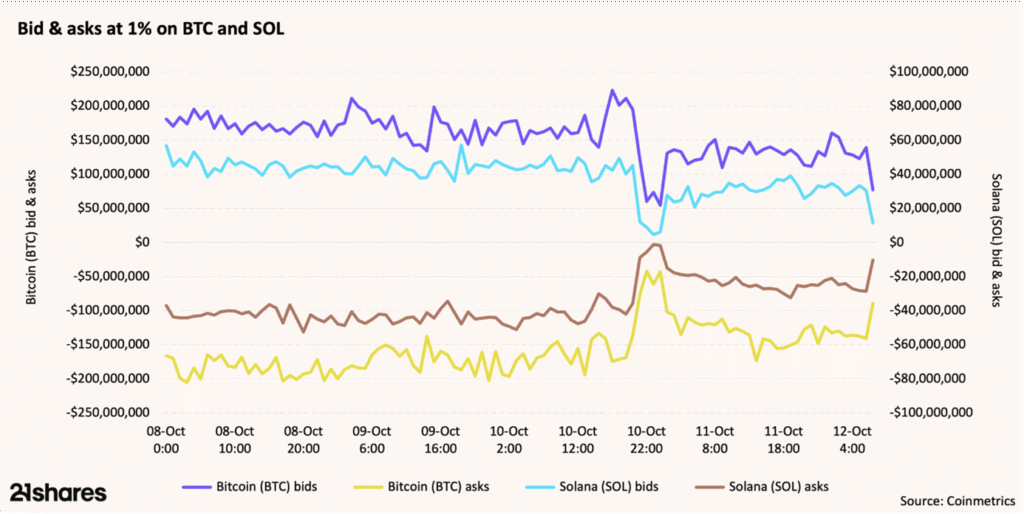
The scale of the move was amplified by fragile liquidity across both spot and derivatives markets. Order books were thin heading into the weekend, leaving markets especially vulnerable to shocks.
The timing compounded the impact:
• The announcement hit just after the U.S. cash equity close and before a long weekend (Columbus Day), when liquidity naturally declines.
• With most global asset classes offline, crypto became the only outlet for risk repricing.
• As liquidity thinned, automated liquidations triggered a domino effect across exchanges.
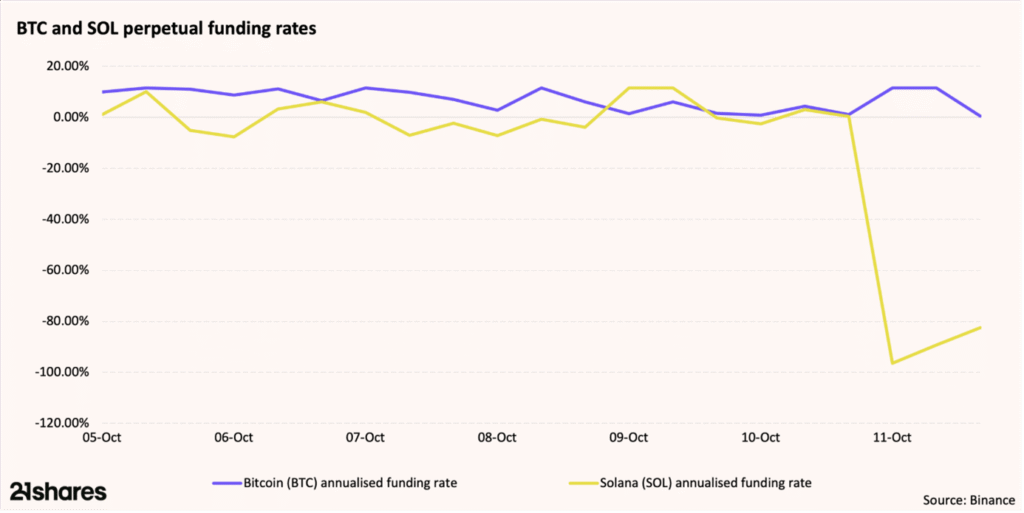
Funding rates flipped sharply negative—particularly in Solana—signaling an abrupt pivot from leveraged longs to short positioning. In some altcoins, liquidity deteriorated so severely that price wicks reached near-zero levels before stabilizing.
Complicating matters, several major exchanges experienced infrastructure strain as trading volumes surged over 140% to ~$180 billion in a matter of hours. APIs froze, oracles glitched, and order books briefly went dark. This led to mispriced liquidations and system-wide stress, highlighting again that crypto’s operational fragility often lies not in blockchains themselves, but in the centralized trading infrastructure that sits around them.
What We’re Hearing from the Market
Market participants describe Friday’s events as a systemic deleveraging that caught even sophisticated funds off guard. Several leveraged traders and funds reportedly suffered heavy losses, and rumors persist of at least one major market maker being forced to unwind positions.
Some internal exchange estimates suggest total liquidations—including unreported DeFi exposures—could approach USD 30 billion once weekend trading is fully accounted for.
Volatility spiked dramatically, with Bitcoin implied volatility reaching levels not seen since the FTX collapse. While unsettling, such spikes are often short-lived and tend to normalize as market depth recovers.
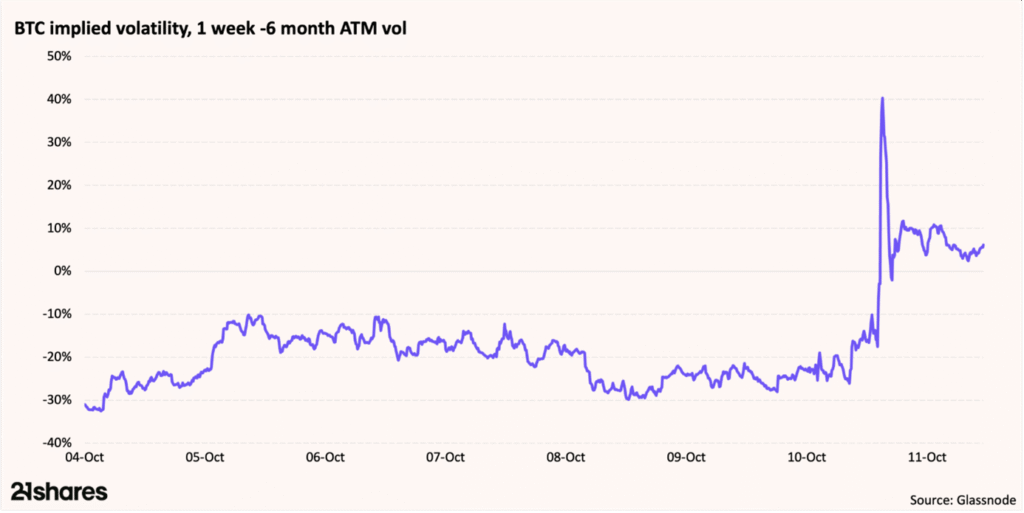
Source: Glassnode
Looking Ahead
Despite the record size of liquidations, the price impact was moderate by historical standards, with Bitcoin’s drawdown smaller than those seen during prior major deleveraging events. Markets had been trading at all-time highs just days earlier, so a correction of this magnitude is not entirely unexpected.
So far, crypto markets appear to be stabilizing, though volumes remain light and sentiment cautious.
Key areas we’re watching in the near term include:
• Asian equity and futures markets as they reopen Monday, which may influence crypto sentiment.
• CME futures basis and funding rates as indicators of capital flows and arbitrage activity.
• Ethereum staking queues, which could become further stretched if the selloff continues.
Historically, large-scale liquidation events have been followed by periods of consolidation lasting one to two months before recovery. The previous two major liquidation cycles saw drawdowns of 19–24% over ~60 days, with full recovery typically taking three to five months.
Currently, Bitcoin funding rates remain within normal ranges, suggesting arbitrage desks continue to operate efficiently. However, with Solana’s funding still deeply negative, we could see a short squeeze if sentiment turns and liquidity returns.
Our View
While last week’s events highlight ongoing structural fragilities—particularly in leverage and centralized infrastructure—they also demonstrate that core blockchain networks remained resilient throughout.
For investors, this underscores the value of crypto exposure via regulated, physically backed ETPs over leveraged trading venues, where forced liquidations and operational risks can amplify volatility.
Overall, we view the selloff as a healthy, if painful, reset of speculative excess. As macro uncertainty persists, disciplined position sizing and diversification across regulated products remain key.
Research Newsletter
Each week the 21Shares Research team will publish our data-driven insights into the crypto asset world through this newsletter. Please direct any comments, questions, and words of feedback to research@21shares.com
Disclaimer
The information provided does not constitute a prospectus or other offering material and does not contain or constitute an offer to sell or a solicitation of any offer to buy securities in any jurisdiction. Some of the information published herein may contain forward-looking statements. Readers are cautioned that any such forward-looking statements are not guarantees of future performance and involve risks and uncertainties and that actual results may differ materially from those in the forward-looking statements as a result of various factors. The information contained herein may not be considered as economic, legal, tax or other advice and users are cautioned to base investment decisions or other decisions solely on the content hereof.















Nya ETF- och ETP-noteringar den 18 juni 2026 på Deutsche Börse

HYHE ETF följer utvecklingen av högavkastande företagsobligationer

Middlefield ser möjligheter inom kanadensisk energi, fastigheter och finans

WDAF ETF investerar i Asiens försvarsindustri

BlackRock utökar tillgången till systematisk aktiv investering för europeiska investerare

USA satsar 2 miljarder dollar på kvantdatorer – så kan investerare dra nytta av utvecklingen

Extrema skillnader: Varför presterar Europas kvantdator-ETFer så olika?

Fastställd utdelning i MONTDIV maj 2026

QQCC ETF följer företag världen över som är aktiva inom kvantberäkning

Varför Plus500 är en dröm för finans-affiliate
-
 Nyheter4 veckor sedan
USA satsar 2 miljarder dollar på kvantdatorer – så kan investerare dra nytta av utvecklingen
-
 Nyheter2 veckor sedan
Extrema skillnader: Varför presterar Europas kvantdator-ETFer så olika?
-
 Nyheter4 veckor sedan
Fastställd utdelning i MONTDIV maj 2026
-
 Nyheter3 veckor sedan
QQCC ETF följer företag världen över som är aktiva inom kvantberäkning
-
 Nyheter3 veckor sedan
Varför Plus500 är en dröm för finans-affiliate
-

 Nyheter3 veckor sedan
ETFer för fotbolls-VM 2026
-

 Nyheter3 veckor sedan
21shares produkter nu finns tillgängliga hos Revolut
-

 Nyheter5 dagar sedan
Den osynliga flaskhalsen i AI-boomen: Varför elinfrastruktur är nästa stora megatrend
