
Nyheter
The Nakamoto Upgrade: Unleashing $1T of Idle Capital

While Bitcoin is scratching new all time highs, there are exciting developments beyond the store of value narrative. Bitcoin’s leading scalability solution, Stacks, has successfully completed the phased rollout of its highly anticipated Nakamoto upgrade, reaching full activation today at Bitcoin block number 867867. Honoring Bitcoin’s anonymous creator, Nakamoto is designed to boost transaction speed, enhance security by anchoring finality to Bitcoin, and resist potential miner manipulation.
Examining the price-to-fees ratio, the crypto equivalent of a P/E ratio, reveals an interesting trend: while the Stacks token price surged over the summer as anticipation for the Nakamoto upgrade grew, it has since stabilized, with fees continuing to increase at a stronger rate than the token’s price. This suggests that, while the token may have been overvalued during peak hype, it now appears relatively undervalued as network activity—and the fees generated— outpace price appreciation. With the Nakamoto upgrade now live and unlocking enhanced features, Stacks is well-positioned for increased adoption.
Figure 1 – Price/Fee Ratio
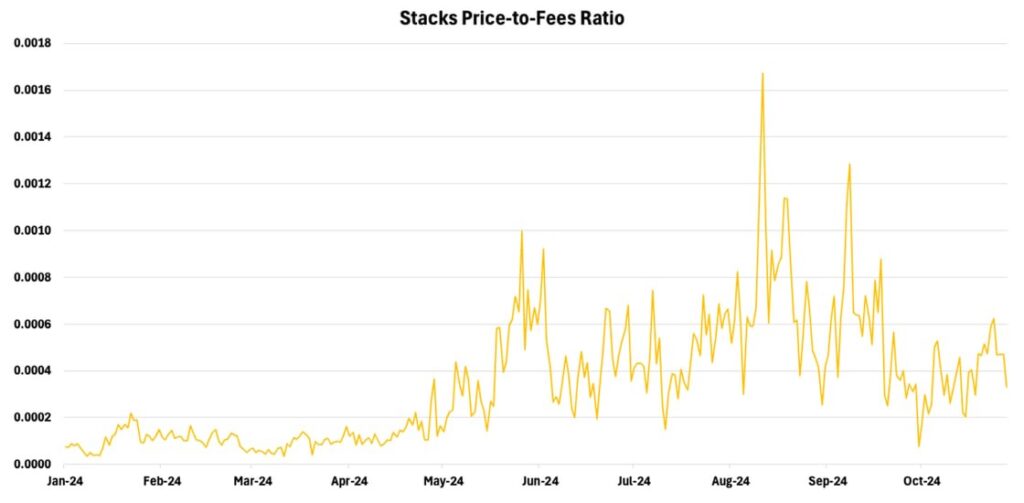
Source: TokenTerminal, 21Shares
Originally announced in late January, the Nakamoto upgrade has now launched following a rigorous testnet phase that began in April, carefully tested for compatibility with Bitcoin’s blockchain and across the broader ecosystem. Throughout this phase, Stacks secured strategic partnerships and integrations, expanding beyond the crypto industry to collaborate with major traditional finance players like Grayscale. Now fully activated, Nakamoto is poised to unlock new possibilities for secure, scalable applications on Bitcoin.
While daily active users on Stacks are currently at relatively low levels under 5K, as shown in Figure 2, the Nakamoto upgrade is expected to revitalize network activity. With enhanced features, Stacks is well-positioned for an uptick in user engagement, attracting new users and developers, such as the expansion to the Solana ecosystem, thereby driving meaningful growth.
Figure 2 – Stacks Daily Active Addresses YTD
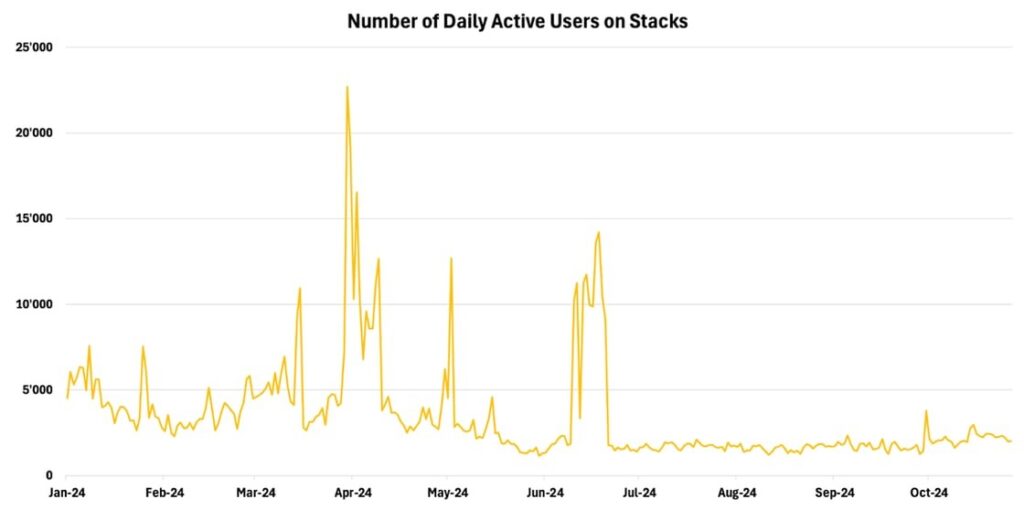
Source: Artemis, 21Shares
What really is Stacks, and how does it work?
Stacks launched in January 2021 to tackle Bitcoin’s scalability challenges, including high latency, limited programmability, and the inability to support complex smart contracts natively. Operating as a Bitcoin Layer 2 solution, Stacks enhances transaction speed by up to 120x and introduces robust smart contract functionality through Clarity, a transparent and secure programming language. By anchoring to Bitcoin’s blockchain, Stacks leverages Bitcoin’s unparalleled security and immutability while enabling a new ecosystem of decentralized applications (dApps) that benefit from Bitcoin’s integrity without sacrificing scalability or programmability.
Token utility: Stacks’ native token, STX, was the first qualified token by the Securities and Exchange Commission (SEC), clearing out any regulatory risks. STX has three primary functions in the Stacks ecosystem:
• Transaction Fees: STX is used to pay transaction fees on the Stacks network, which have averaged $0.72 this year and as low as $0.01 in some cases.
• Smart Contract Execution: STX enables the deployment and execution of smart contracts, expanding Bitcoin’s programmability.
• Network Consensus Participation: Stacks operates using a unique Proof of Transfer (PoX) consensus model, which connects Stacks directly to Bitcoin’s blockchain. To secure the network and mint new blocks, ”Stackers” lock up STX and commit BTC in exchange for the chance to earn stacking rewards.
o This mechanism aligns incentives, strengthens network security, and creates an economic bridge between STX and BTC. By participating, STX holders contribute to the network’s security while earning yield in BTC, offering a distinct value proposition and deepening the synergy between the two blockchains.
Stacks’ Total Value Locked (TVL) has been on a growth trajectory, driven by the promise of fast Bitcoin transactions and Bitcoin-backed decentralized finance (DeFi) applications. While dollar-denominated TVL reached an all-time high in April following the testnet launch, recent price fluctuations in STX have brought the current TVL to $100M, as shown in Figure 3. However, in STX terms, the value accrued is actually approaching its all-time high, demonstrating strong network engagement and sustained demand for Stacks’ utility, a trend poised to continue, following the Nakamoto upgrade.
Figure 3 – Stacks TVL Composition
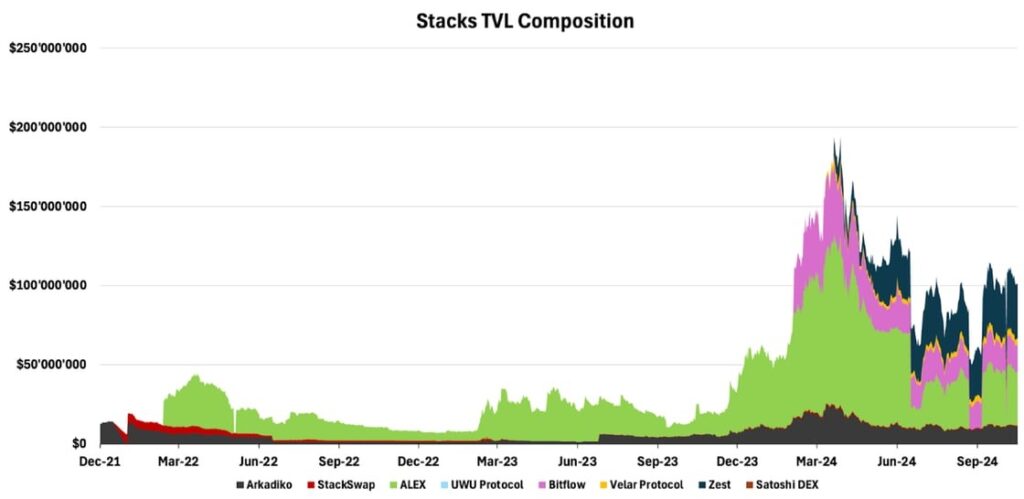
Source: DefiLlama, 21Shares
How is the Nakamoto upgrade expected to work?
Without altering anything on the core Bitcoin network, Nakamoto is a hard fork on the Stacks blockchain that has a dual effect on Bitcoin; the utility of idle BTC and the scaling of the network to unlock Bitcoin’s capabilities to house its iteration of DeFi. Here are the main takeaways from the Nakamoto upgrade:
• Unlocking BTC: A key component of the Nakamoto upgrade is sBTC, a synthetic derivative with a decentralized, two-way peg mechanism with Bitcoin, unleashing nearly $1T in idle BTC, infusing utility in the broader DeFi landscape.
• Speed: Stacks will introduce faster block processing times, enabling transactions to be finalized in under 5 seconds, a significant improvement from Bitcoin’s average of 10 minutes.
• Security: Bitcoin’s robust security guarantees make transaction reversals on the Stacks network as challenging as those on the Bitcoin network.
Stacks on the Bitcoin map: risks and advantages
A decentralized peg enables BTC to become a productive asset, allowing it to be deployed in applications like BTC-based decentralized lending, BTC-backed stablecoins, and other innovative use cases. The Nakamoto upgrade is poised to arm Stacks for fierce competition from established and emerging projects on the Bitcoin network.
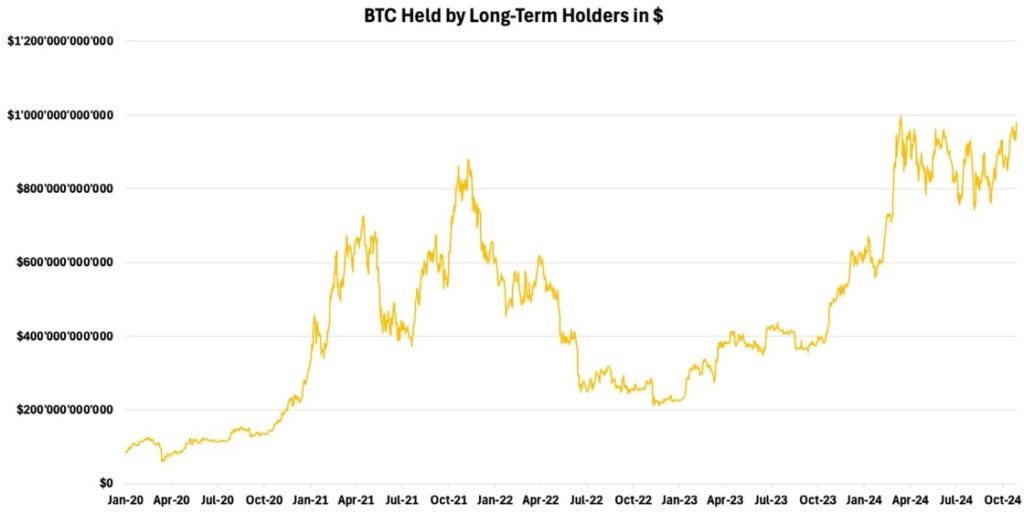
This year has been a playground for new and existing solutions integrating compatibility with Ethereum’s Virtual Machine (EVM) and unlocking Bitcoin’s potential in securing other proof-of-stake blockchains while expanding its role in the DeFi industry. Currently, only 0.012% of BTC’s supply is locked in DeFi, but this share is expected to grow significantly as more platforms develop ways to bring new utility to the over 14M BTC or nearly $1T worth held by long-term investors, as shown in Figure 4. As Bitcoin becomes more accessible for DeFi applications, its influence within the broader ecosystem is set to expand considerably.
Figure 4 – BTC: Long-term Holder Supply
Source: Glassnode, 21Shares
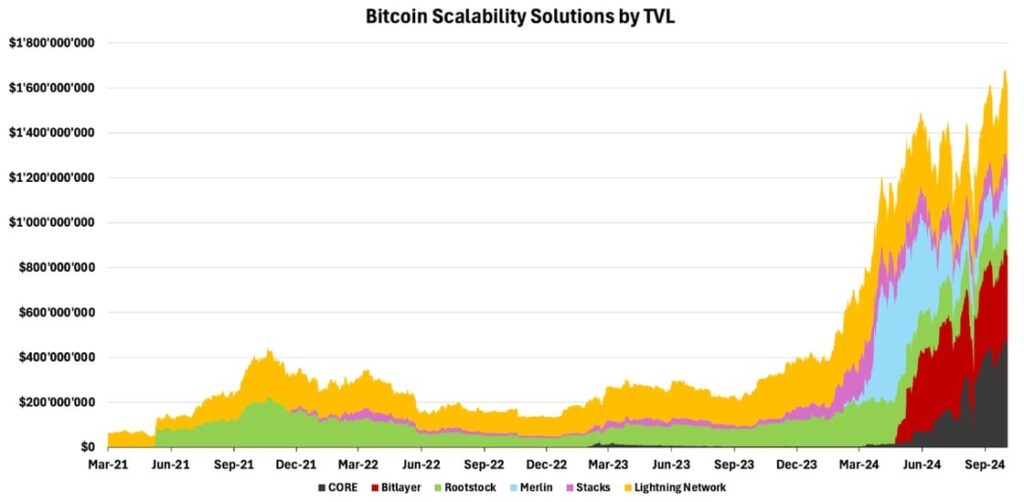
Who are Stacks’ competitors? Initially, Stacks competed with Bitcoin’s established state channel, Lightning Network, in terms of transaction speed and lower fees. However, Stacks has since shifted its focus beyond this space, pioneering smart contract functionality on Bitcoin. It is not alone in this endeavor; platforms like Bitlayer and Core DAO are also enhancing Bitcoin’s utility through dual-staking models that integrate BTC into staking and re-staking protocols. As shown in Figure 5, these platforms have achieved significant growth, securing over $1.6B in BTC. The following scalability solutions are setting new standards for scaling Bitcoin:
• Core: EVM-compatible blockchain, allowing users to stake their BTC or CORE tokens, build dApps, while offering miners an opportunity to diversify their revenue streams, earning yield by securing Core. Launched in 2023, Core enjoys the lion’s share of TVL and active users.
• Bitlayer: The newest among them, launched in April 2024, is a BitVM-based sidechain allowing an ecosystem of dApps. BitLayer is ready for 2025, with a hybrid model launching, OpVM, combining BitVM and OP_CAT, fraud and validity proofs, to streamline the onboarding of staking, re-staking, real-world assets (RWAs), and yield opportunities, making Bitcoin more versatile and accessible within DeFi.
• Rootstock: A sidechain launched in 2018 that allows BTC holders to interact with DeFi protocols using their wrapped Bitcoin, RBTC. Rootstock aims to reduce transaction confirmation times to 5 seconds in the upcoming year, increasing transaction throughput while enhancing decentralization.
• Merlin: A zero-knowledge roll-up launched in April 2024, allowing fast, low-cost BTC transactions and interactions with Ethereum-compatible dApps. By integrating decentralized oracles, Merlin unlocks real-world data to interact securely with smart contracts, elevating Bitcoin’s DeFi ecosystem.
Despite holding a modest share of the total TVL market, Stacks stands as the largest Bitcoin scalability solution by market cap, with its token appreciating 197% over the past year. The loyalty of long-term holders, coupled with Stacks’ strategic partnerships, positions the network to leverage the Nakamoto hard fork as a catalyst for growth. This upgrade is set to enhance Stacks’ role in expanding Bitcoin’s utility and strengthening its market presence.
Figure 5 – Bitcoin Scalability Solutions by TVL
Source: DeFiLlama, 21Shares
The Bitcoin and Stacks ETP Market in Europe
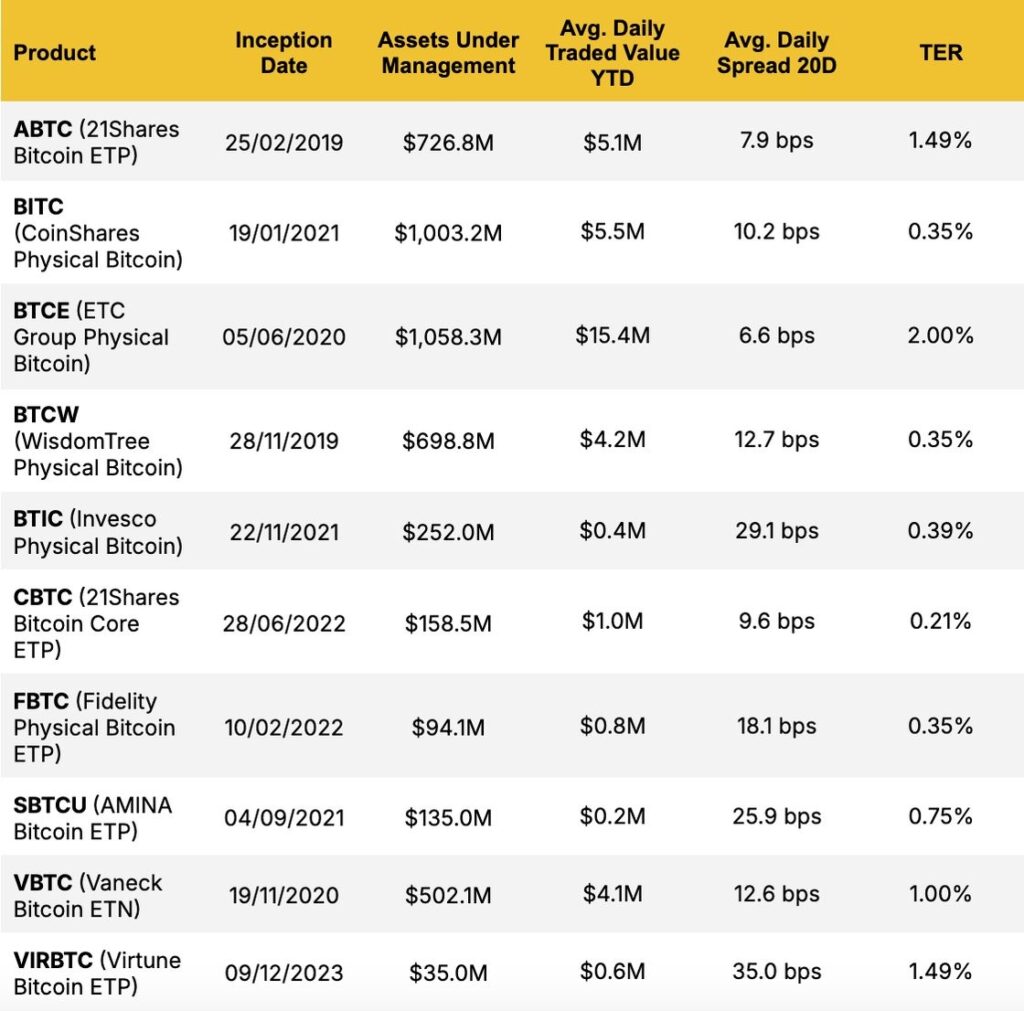
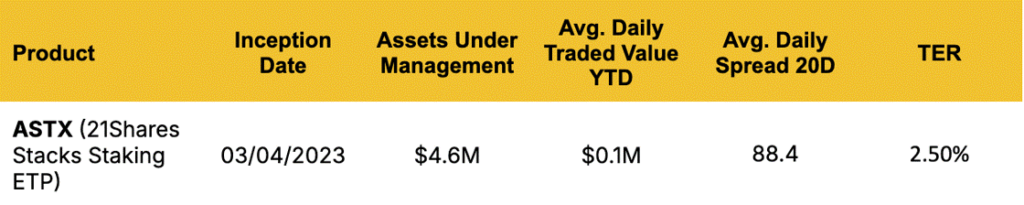
Europe has emerged as a global leader in innovative crypto exchange-traded products (ETPs). The substantial institutional demand for Bitcoin within the European ETP market is underscored by its $4.24B assets under management (AuM), as depicted in Figure 6. Nevertheless, Europe pioneered the launch of the first Stacks ETP, which has attracted $4.6M in investments, as shown in Figure 7. As Bitcoin continues its trajectory as a digital store of value, complemented by Stacks’ advancements to enhance Bitcoin’s utility, these ETPs represent a strategic opportunity to engage with the evolution of secure, decentralized technology anchored to Bitcoin.
Figure 6 – The Top 10 Bitcoin ETPs by AuM Across the European market
Source: Bloomberg, Data as of October 29, 2024.
Avg. Daily Spread 20D: refers to the best daily average bid/ask spread over the last 20 days across European exchanges.
Figure 7 – Stacks ETPs Across the European Market
Source: Bloomberg, Data as of October 29, 2024.
Avg. Daily Spread 20D: refers to the best daily average bid/ask spread over the last 20 days across European exchanges.
What’s happening this week?
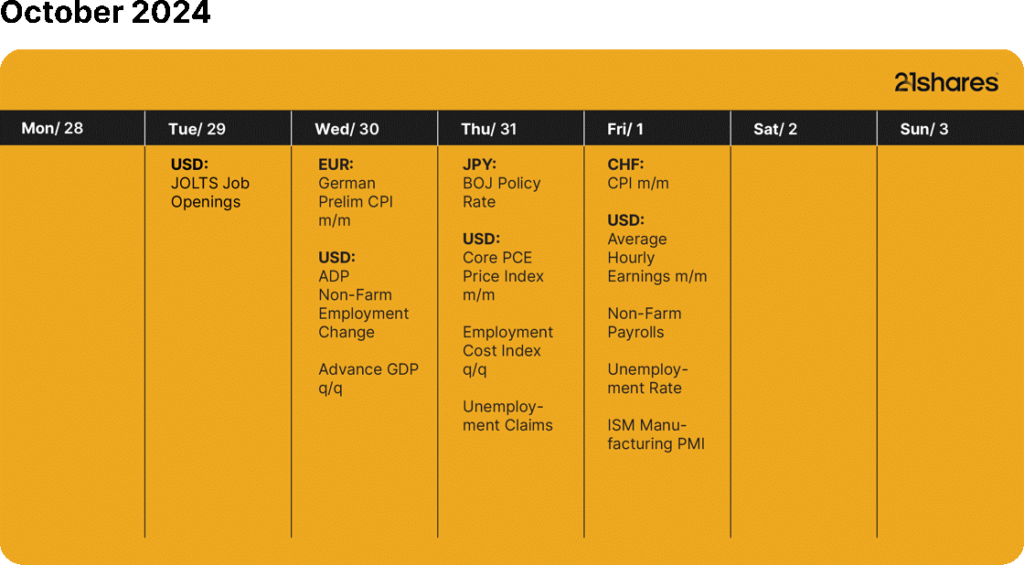
Research Newsletter
Each week the 21Shares Research team will publish our data-driven insights into the crypto asset world through this newsletter. Please direct any comments, questions, and words of feedback to research@21shares.com
Disclaimer
The information provided does not constitute a prospectus or other offering material and does not contain or constitute an offer to sell or a solicitation of any offer to buy securities in any jurisdiction. Some of the information published herein may contain forward-looking statements. Readers are cautioned that any such forward-looking statements are not guarantees of future performance and involve risks and uncertainties and that actual results may differ materially from those in the forward-looking statements as a result of various factors. The information contained herein may not be considered as economic, legal, tax or other advice and users are cautioned to base investment decisions or other decisions solely on the content hereof.














OTUS ETF ger exponering mot en portfölj av globala aktier

Defiance utökar sitt europeiska utbud med lanseringen av Europas första minnes-ETF

KBOT ETF investerar i humanoida robotar

HANetf blir den största ETF-utgivaren på Warszawabörsen, med 8 nya UCITS ETF-noteringar och fler på gång

ASWA ETF ger exponering mot kärnbränsle- och energiindustrin

USA satsar 2 miljarder dollar på kvantdatorer – så kan investerare dra nytta av utvecklingen

Extrema skillnader: Varför presterar Europas kvantdator-ETFer så olika?

QQCC ETF följer företag världen över som är aktiva inom kvantberäkning

Fastställd utdelning i MONTDIV maj 2026

Varför Plus500 är en dröm för finans-affiliate
-
 Nyheter4 veckor sedan
USA satsar 2 miljarder dollar på kvantdatorer – så kan investerare dra nytta av utvecklingen
-
 Nyheter3 veckor sedan
Extrema skillnader: Varför presterar Europas kvantdator-ETFer så olika?
-
 Nyheter3 veckor sedan
QQCC ETF följer företag världen över som är aktiva inom kvantberäkning
-
 Nyheter4 veckor sedan
Fastställd utdelning i MONTDIV maj 2026
-
 Nyheter3 veckor sedan
Varför Plus500 är en dröm för finans-affiliate
-

 Nyheter3 veckor sedan
ETFer för fotbolls-VM 2026
-

 Nyheter3 veckor sedan
21shares produkter nu finns tillgängliga hos Revolut
-

 Nyheter6 dagar sedan
Den osynliga flaskhalsen i AI-boomen: Varför elinfrastruktur är nästa stora megatrend
