
Nyheter
Primer: Injective, infrastructure for global finance


• Injective is a high-performance Layer-1 blockchain purpose-built for finance, featuring 25,000+ TPS, instant finality, and near-zero fees averaging $0.0003 per transaction.
• The platform’s 12+ native Web3 modules provide pre-built, customizable financial infrastructure, including an on-chain central limit orderbook and real-world asset tokenization suite.
• INJ, the network’s native token, features a unique programmable economy with a Burn Auction mechanism that aligns value accrual with ecosystem growth rather than network congestion.
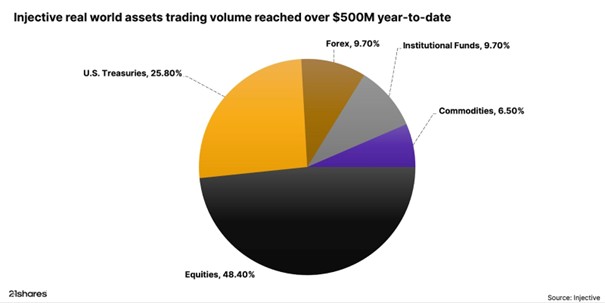
• Injective’s iAssets represent a breakthrough in tokenizing real-world assets, creating capital-efficient instruments without user collateralization, with over $500M in trading volume and 60% weekly market share YTD for on-chain equities trading.
• The platform’s revolutionary Liquidity Availability framework transforms liquidity management from application-specific silos to a network-wide resource, significantly reducing barriers to entry for new applications and maximizing capital efficiency across the ecosystem.
• The platform’s multi-VM compatibility and continued expansion across virtual machine environments position Injective as a universal settlement layer for global finance, bridging traditional markets with blockchain innovation.
Introduction
Injective is a specialized layer-1 blockchain designed to serve as the technological foundation for the future of finance. Founded in 2018, Injective was conceived to address fundamental limitations in blockchain-based financial applications, where existing solutions were often rudimentary, cumbersome to use, and lacked adequate security measures. Since its inception, Injective has evolved into a high-performance Layer-1 that combines exceptional transaction throughput, sub-second finality, and near-zero fees with native financial primitives specifically engineered for sophisticated financial operations.
At its core, Injective differentiates itself through its purpose-built architecture that optimizes for financial use cases. The network leverages a robust technical stack enhanced by strategic refinements to the base technology, creating a blockchain ecosystem that achieves impressive performance metrics while maintaining security and decentralization. With transaction processing capabilities of up to 25,000 TPS, instant transaction finality, and block times of 640ms, Injective delivers an institutional-grade infrastructure capable of handling the demands of global financial markets.
The platform’s modular approach to functionality provides developers with pre-built and customizable infrastructure components, allowing for rapid implementation of sophisticated financial applications. This includes native support for an on-chain central limit order book (CLOB), derivatives markets, and real-world asset (RWA) tokenization. Additionally, Injective’s interoperability capabilities enable seamless interaction with multiple blockchain ecosystems, supporting both the Ethereum Virtual Machine (EVM) and Solana Virtual Machine (SVM) while maintaining compatibility with Inter-Blockchain Communication (IBC) protocol.
Powering this ecosystem is INJ, the network’s native token, which features a programmable token economy designed for deflationary acceleration through its innovative Burn Auction mechanism. By decoupling transaction fees from deflationary pressure, Injective has created an economic model that scales with ecosystem growth rather than network congestion, positioning it for sustainable long-term development.
As traditional finance continues to explore blockchain integration, Injective stands at the intersection of these converging worlds, offering a blockchain solution specifically calibrated for financial operations with the performance, security, and functionality required by institutional participants.
How Injective Works
Injective operates on a refined blockchain architecture that prioritizes transaction efficiency, security, and financial application optimization. This section outlines the core technical components that enable Injective’s high-performance capabilities and specialized financial functionality.
Consensus Mechanism
Injective employs a Tendermint-based Proof of Stake (PoS) consensus mechanism, enhanced with proprietary optimizations to achieve industry-leading performance metrics. This consensus model enables validators to secure the network by staking INJ tokens, with transaction validation occurring through a Byzantine Fault Tolerant (BFT) process that provides instant finality. This is a critical feature for financial applications requiring immediate settlement confirmation.
What sets Injective’s consensus mechanism apart from traditional architectures are several key innovations that dramatically accelerate block production and network-wide agreement:
• Streamlined finalization process: Unlike conventional consensus mechanisms that require multiple rounds of validation, Injective implements a highly efficient two-step finalization process consisting only of pre-vote and pre-commit phases before block generation. This streamlined approach eliminates unnecessary validation rounds, enabling the network to achieve consensus and generate new blocks with exceptional speed while maintaining the security guarantees of BFT.
• Deterministic Round-Robin proposer selection: Injective’s proposer selection method eliminates the competition and chance-based racing typically found in other blockchain networks. Rather than validators competing to propose the next block (a process that can introduce delays and network inefficiencies), Injective’s deterministic selection ensures predictable, orderly block proposal. This systematic approach allows the entire network to optimize for consensus propagation, as validators know exactly when their turn arrives, enabling them to prepare and coordinate more effectively across the network.
• Decoupled consensus and execution architecture: Perhaps most significantly, Injective’s consensus mechanism is carefully engineered to decouple consensus operations from the execution layer. This architectural separation abstracts transaction processing concerns from the core consensus mechanism, allowing the consensus layer to focus exclusively on its primary responsibility: ensuring all nodes accept state updates in a coordinated manner. By removing execution complexity from consensus operations, the system can achieve faster agreement on network state while maintaining the flexibility to optimize transaction processing independently.
• Direct validator peering: Injective’s direct peering architecture allows validators to establish dedicated connections with one another, bypassing traditional network routing inefficiencies. Unlike conventional chain architectures that rely on gossip protocols or indirect communication paths that can introduce latency bottlenecks, Injective’s validators communicate directly with each other. This direct connectivity dramatically reduces message propagation time across the network, enabling faster consensus rounds and more efficient coordination during the validation process.
These four consensus innovations work synergistically to deliver Injective’s exceptional performance metrics of 25,000+ TPS with 640ms block times and instant finality. By optimizing each layer of the consensus process while maintaining Byzantine Fault Tolerance, the network achieves transaction processing efficiency comparable to traditional finance systems without compromising the security and decentralization properties essential for institutional-grade financial infrastructure.
Native Web3 Modules
Central to Injective’s value proposition is its suite of native Web3 modules, which provide pre-built, customizable infrastructure for rapidly implementing sophisticated functionality. These modules are optimized to work together harmoniously, delivering high transaction throughput, low latency, and cost-effective operations without requiring complex smart contract development.
Exchange Module
The Exchange Module represents one of Injective’s most significant innovations, facilitating a fully decentralized spot and derivative exchange environment through an on-chain central limit order book that fundamentally transforms how decentralized trading operates.
• Advanced market structure and MEV protection: At its core, the Exchange Module implements an on-chain CLOB that enables efficient price discovery and trade execution while eliminating front-running through frequent batch auctions (FBA). By processing transactions in discrete intervals with sealed bids and uniform clearing prices, the module prevents Maximum Extractable Value (MEV) strategies, ensuring fair and transparent markets where all participants have equal access to optimal pricing.
• Professional liquidity infrastructure: What distinguishes Injective’s on-chain experience is its integration with professional, trusted financial firms that supply liquidity for high-volume, complex trades. This institutional-grade liquidity provision creates a trading environment that rivals centralized exchanges in depth and sophistication, while maintaining the transparency and accessibility benefits of decentralized infrastructure.
• Shared liquidity architecture: The Exchange Module’s implementation as a native blockchain module delivers two transformative advantages.
o First, since any Injective dApp can access the module directly, it creates a shared liquidity environment across the entire chain. This eliminates much of the persistent challenges in DeFi related to liquidity, such as fragmentation, bootstrapping, and sufficient depth.
o Second, this chain-level architecture, combined with the inherent advantages of a CLOB over Automated Market Makers (AMMs), largely eliminates the necessity for Total Value Locked (TVL) as a prerequisite for facilitating sophisticated DeFi activities. Traditional DeFi protocols require massive capital deposits to provide adequate liquidity, but Injective’s shared orderbook model enables efficient trading without requiring users to lock capital in liquidity pools.
• Exceptional capital efficiency: This architectural innovation demonstrates remarkable results in practice. Despite maintaining only $30-70M in TVL, Injective has facilitated over $55B in trading volume across spot and derivative markets, with most days exceeding $100M in daily volume. This represents a capital efficiency ratio that is orders of magnitude superior to traditional DeFi approaches.
• Comprehensive financial instruments Market participants can engage with various financial instruments, including spot trading, perpetual swap markets, futures markets, and binary options, all processed through native blockchain logic rather than complex smart contracts. This approach delivers substantial performance advantages, including faster execution, lower costs, and reduced attack surfaces, while maintaining the security and transparency benefits of decentralized trading.
The Exchange Module’s combination of institutional-grade liquidity, shared architecture, and capital efficiency creates a trading environment that bridges the performance gap between centralized and decentralized exchanges, establishing a new standard for on-chain financial markets.
Real-world asset Module
Introduced in January 2024, Injective’s real-world asset (RWA) module provides institutions with a compliance-focused solution for launching permissioned asset-backed tokens. This module enables organizations to maintain full control over which addresses can interact with specific assets, supporting regulatory compliance requirements while unlocking the efficiency benefits of blockchain technology.
Through the RWA module, institutions can launch and access various structured products, including tokenized fiat pairs, treasury bills, and exclusive credit products. This capability has attracted notable institutions to the Injective ecosystem, including Libre Capital, Ondo Finance, and Paxos, signaling growing institutional adoption of the platform.
Comprehensive module ecosystem
Beyond the Exchange and RWA modules, Injective offers a diverse suite of native modules that form a comprehensive financial infrastructure. These include oracle services for reliable price feeds, token creation for asset issuance, bridging for cross-chain asset transfers, and specialized features like AI agents, binary options, and other financial instruments.
What distinguishes Injective’s approach is that these modules serve as both ready-to-use solutions and customizable building blocks. Developers can immediately leverage modules for instant functionality without complex coding requirements, while still retaining the flexibility to modify, extend, and customize them to meet specific business requirements or create entirely new financial primitives. This dual nature, providing both turnkey solutions and flexible components, empowers developers to rapidly launch standard applications or innovate entirely new financial products without sacrificing control over implementation details. Injective’s commitment to this adaptable modular architecture ensures the platform can support both established financial use cases and emerging innovations while maintaining the performance and security standards required for institutional finance.
Multi-VM environment and interoperability
Injective’s architecture supports multiple virtual machine environments, including EVM, SVM, and WASM. This multi-VM approach ensures compatibility with existing decentralized applications while enabling developers to leverage the unique strengths of different blockchain ecosystems.
The platform’s advanced smart contracting layer is designed for high interoperability, facilitating the development of complex cross-chain applications. Multichain smart contracts on Injective support cross-chain bridging and execution, enabling interaction with Ethereum, Solana, and any IBC-enabled blockchain. This interoperability unlocks access to assets and functionalities from hundreds of other blockchains, enhancing overall liquidity and enabling sophisticated cross-chain financial applications.
Injective’s multi-VM initiative represents a fundamental advancement in blockchain architecture, delivering a wholly unified development environment that transcends the limitations of traditional single-VM chains. Unlike other implementations that deploy virtual machines as Layer-2 solutions that must settle back to a main chain, VMs like Injective’s EVM are enshrined directly in the core architecture as native components.
Native integration creates an advantage unique to only Injective. When developers deploy EVM code and applications on Injective, they gain access not only to familiar Ethereum tooling and functionality, but also to Injective’s entire suite of innovative native modules including the Exchange module, RWA module, automatic smart contracts, and the broader financial infrastructure ecosystem. This composite leverage allows developers to combine the strengths of different virtual machine environments with Injective’s purpose-built financial primitives, a capability that simply doesn’t exist on other chains.
The result is an unprecedented development environment where applications can simultaneously utilize EVM compatibility for familiar smart contract logic while tapping into Injective’s native orderbook for trading functionality, RWA tokenization capabilities, and other specialized financial modules. This architectural approach eliminates the trade-offs typically faced by developers who must choose between VM compatibility and access to advanced financial infrastructure, instead offering both within a single, unified platform.
Performance optimizations
Injective has implemented several core technological optimizations that enable its exceptional performance metrics:
• High throughput: The custom consensus mechanism achieves transaction processing speeds of 25,000+ TPS, significantly outperforming many leading blockchain networks.
• Instant finality: Transactions are confirmed immediately without requiring additional block confirmations, eliminating wait times for settlement certainty—a critical feature for financial operations.
• Sub-second block times: Injective maintains rapid block production at 640ms intervals, allowing for near-instantaneous transaction inclusion while preserving network security and consensus integrity.
• Low latency: Direct validator peering dramatically reduces network latency, enabling faster propagation of transactions and blocks across the network.
• Native module integration: Modules embedded directly in the blockchain architecture eliminate computational overhead, providing higher performance, lower gas costs, and stronger security than smart contract implementations.
• Near-zero fees: The refined consensus and Gas Compression upgrade implemented in January 2024 maintain transaction costs averaging around $0.0003 per transaction, making frequent trading economically viable.
These performance characteristics place Injective among the most efficient blockchain networks in operation today, particularly for financial applications where speed, cost, and reliability are paramount considerations.
By combining these technical elements with specialized financial primitives, Injective delivers a blockchain infrastructure specifically calibrated for the demands of modern financial operations, creating a foundation for innovative financial applications that bridge traditional and decentralized finance.
The INJ token
INJ is the native token powering the Injective blockchain, featuring a unique economic design engineered for long-term value accrual and network sustainability.
Token utility
INJ serves three essential functions within the Injective ecosystem:
• Medium of Exchange: INJ is used for transaction fees and network activity across the platform
• Network Security: Validators and delegators stake INJ to secure the network through Proof of Stake consensus
• Governance: Token holders can participate in on-chain decision-making for protocol upgrades and parameters
Programmable token economy
What distinguishes INJ from other Layer-1 tokens is its programmable economic model built around two complementary mechanisms:
Dynamic supply mechanism
The network employs a programmatic approach to token issuance through the Mint module, which automatically adjusts supply rates to maintain an optimal ratio of staked-to-circulating tokens. This mechanism operates within predetermined bounds that decrease quarterly through 2026, creating a steady path toward increased scarcity over time as the deflation rate increases by 400% from its initial implementation.
Burn auction mechanism
Injective’s novel Burn Auction system represents a significant innovation in token economics by decoupling deflationary pressure from network usage. Rather than burning transaction fees, which can create tension between scalability and value accrual, Injective conducts weekly auctions where participants bid with INJ tokens for a basket of assets generated from ecosystem application revenue. The winning bid is permanently burned, removing those tokens from circulation. As of June 2025, over 6.6M INJ has been burned via the Burn Auction, with 753,000+ having been burned in the last year.
As a result, Injective is able to decouple fees from deflationary activity, unlike typical on-chain economic models employed by prominent smart contract platforms.
This economic design aligns network value accrual with ecosystem growth rather than network congestion. As applications on Injective become more successful, they contribute more value to the Burn Auction, accelerating the deflationary effect without requiring higher transaction fees. Combined with Injective’s dynamic supply mechanism, a powerful economic flywheel that naturally scales with the success of the platform is created, benefiting both users and applications.
The future of Injective
Injective stands poised to redefine global financial infrastructure through three strategic pillars that will drive the next generation of on-chain finance: tokenized assets, enhanced liquidity models, and expanding virtual machine compatibility.
iAssets: Bringing global markets on-chain
One of the most transformative developments in Injective’s roadmap is iAssets, a groundbreaking approach to bringing real-world assets on-chain. Unlike traditional tokenization that simply creates basic digital representations, iAssets represent a significant advancement in financial technology.
iAssets leverage Injective’s specialized infrastructure to create capital-efficient, programmable instruments without requiring user collateralization or capital lock-ups.
*This approach enables truly composable financial primitives that can function seamlessly across various applications and strategies. The key advantages of iAssets include:
• Capital Efficiency: iAssets operate without traditional collateralization requirements, maximizing capital utilization while maintaining security.
• Programmability: As natively digital assets, iAssets unlock unprecedented use cases beyond simple ownership, from lending and hedging to yield generation and sophisticated trading strategies.
• Liquidity: iAssets benefit from Injective’s shared liquidity layer and on-chain orderbook, ensuring deep markets and minimal slippage. This feature eliminates the need for conventional tokenization, where capital is parked on-chain such that a digital representation of an RWA can be minted.
• Accessibility: With 24/7 trading capabilities, global access, and instant settlement, iAssets eliminate the geographical and temporal restrictions of traditional markets.
This approach to tokenizing equities, commodities, forex pairs, and other traditional assets represents a crucial building block in Injective’s vision for the future of finance. By enabling second-order utility for global markets, ETFs, and stocks on blockchain rails, Injective is delivering genuinely transformative innovation. To date, Injective iAssets have traded over $500M in volume, amassing 60% average weekly market share in equities trading across all chains. As the market for tokenized assets continues to expand, with estimates suggesting it could reach $30T by 2030, we’re witnessing the future state of capital markets taking shape in real-time on Injective.
Liquidity availability: Redefining capital efficiency
Liquidity has long been the cornerstone of functional financial markets, yet traditional blockchain architectures struggle with liquidity fragmentation across siloed applications. Injective is pioneering a revolutionary approach to this challenge through the concept of Liquidity Availability, transforming liquidity from an application-specific resource into a network-wide asset.
This framework enables the mobilization of liquidity across the entire ecosystem, allowing applications to access capital when needed without maintaining dedicated liquidity pools. By abstracting liquidity management to the network level, Injective’s approach significantly lowers barriers to entry for new projects and creates a more collaborative financial ecosystem where capital efficiency is maximized across all applications.
The implications are profound: new financial applications can launch and iterate more quickly, traders experience deeper markets with reduced slippage, and the entire ecosystem benefits from improved capital utilization. This advancement represents a fundamental shift from the current model, where applications compete for limited liquidity, toward a cooperative environment that accelerates innovation.
Multi-VM expansion: Unifying blockchain ecosystems
Injective continues to expand its multi-virtual machine compatibility beyond its current native support for EVM, WASM, and SVM via SonicSVM. Potential expansions being explored include native support for SVM, as well as others like Move-based VMs and Zero-Knowledge Virtual Machines (zkVMs). Injective’s approach of gradual expansion across existing and emerging VMs is a long-term commitment to creating a unified environment at every level, from developer to everyday users.
This development strategy positions Injective as a universal settlement layer for global finance, capable of executing transactions from any major blockchain environment without compromise. The multi-VM approach allows developers to write applications in their preferred language and framework while still benefiting from Injective’s performance optimizations and financial primitives.
By embracing this inclusive architecture, Injective is breaking down the walled gardens that have limited blockchain adoption, creating a unified platform where assets and applications can seamlessly interact regardless of underlying frameworks.
A foundation for global financial infrastructure
Together, these three pillars – iAssets, Liquidity Availability, and multi-VM expansion – establish Injective as a comprehensive foundation for the future of global financial markets. As traditional finance increasingly embraces blockchain-based systems, Injective’s specialized infrastructure offers the performance, interoperability, and financial primitives needed to support institutional adoption at scale.
The vision extends beyond simply improving existing financial processes; it aims to enable entirely new financial models that weren’t possible in traditional systems. With sub-second finality, near-zero fees, and purpose-built financial infrastructure, Injective is creating an environment where innovation can flourish, ultimately driving broader participation in the global economy.
As these developments continue to mature, Injective is positioned to become the platform of choice for sophisticated financial operations, powering everything from tokenized securities to cross-border payments and novel financial instruments yet to be conceived.
Research Newsletter
Each week the 21Shares Research team will publish our data-driven insights into the crypto asset world through this newsletter. Please direct any comments, questions, and words of feedback to research@21shares.com
Disclaimer
The information provided does not constitute a prospectus or other offering material and does not contain or constitute an offer to sell or a solicitation of any offer to buy securities in any jurisdiction. Some of the information published herein may contain forward-looking statements. Readers are cautioned that any such forward-looking statements are not guarantees of future performance and involve risks and uncertainties and that actual results may differ materially from those in the forward-looking statements as a result of various factors. The information contained herein may not be considered as economic, legal, tax or other advice and users are cautioned to base investment decisions or other decisions solely on the content hereof.














Vilken typ av sektor ETFer finns det?

LVLD ETF investerar i ett urval av företag världen över med låg volatilitet

Den europeiska ETF-revolutionen: Skiftet som ritar om kartan för kapitalförvaltning

EEAK ETF investerar i eurodenominerade statsobligationer från eurozonen

HEQQ ETF mål är att ge långsiktig kapitaltillväxt

USA satsar 2 miljarder dollar på kvantdatorer – så kan investerare dra nytta av utvecklingen

Extrema skillnader: Varför presterar Europas kvantdator-ETFer så olika?

QQCC ETF följer företag världen över som är aktiva inom kvantberäkning

Fastställd utdelning i MONTDIV maj 2026

Varför Plus500 är en dröm för finans-affiliate
-
 Nyheter4 veckor sedan
USA satsar 2 miljarder dollar på kvantdatorer – så kan investerare dra nytta av utvecklingen
-
 Nyheter3 veckor sedan
Extrema skillnader: Varför presterar Europas kvantdator-ETFer så olika?
-
 Nyheter3 veckor sedan
QQCC ETF följer företag världen över som är aktiva inom kvantberäkning
-
 Nyheter4 veckor sedan
Fastställd utdelning i MONTDIV maj 2026
-
 Nyheter3 veckor sedan
Varför Plus500 är en dröm för finans-affiliate
-

 Nyheter3 veckor sedan
ETFer för fotbolls-VM 2026
-

 Nyheter1 vecka sedan
Den osynliga flaskhalsen i AI-boomen: Varför elinfrastruktur är nästa stora megatrend
-

 Nyheter4 veckor sedan
21shares produkter nu finns tillgängliga hos Revolut
