
Nyheter
Oct. 24 crypto market update & Performance attribution Hashdex Crypto Index ETPs

Please find below Hashdex monthly crypto market update and performance attribution for Hashdex Crypto-Index ETPs for October 2024.
With October often showing strong seasonality for crypto assets, this month’s results reflect a promising trend for Bitcoin, although gains were more limited across Altcoins. As outlined in our latest CIO note, “Beyond Trump and Harris: Five Congressional Races That May Impact Crypto’s Future”, several upcoming US congressional races could shape the regulatory landscape for crypto, with potential implications for institutional adoption and future price action. Bipartisan support for the asset class is expected to grow, depending on the results of key races.
We will share some updates during the week, if you need any inputs on US elections, feel free to reach out to us.
Hashdex Crypto Index ETPs: performances (USD) as of end of October 24
• Beta Index ETP – Nasdaq Crypto Index ETP (HASH or HDX1) (largest Crypto Index ETP in Europe): October +7.1%, YTD +45%, 12M +89%.
• Smart-Beta Index ETP – Crypto Momentum Index ETP (HAMO or HDXM): October -0.5%, YTD +1.2%, 12M +71%.
Market Update – October 24
October, commonly known as ”Uptober” for its seasonally strong performance for Bitcoin, continued this trend in 2024. The month began with a volatile period, as the Nasdaq Crypto Index (NCI) initially gave back gains from September. All NCI constituents declined in the first ten days, with the exception of Uniswap, which announced plans for its own layer-two network on Ethereum.
Mid-month, the sentiment shifted, with a sharp rally that drove Bitcoin close to its all-time high by the 29th. The NCI ultimately closed the month up 7.1%, significantly outpacing traditional markets as both the S&P 500 and Nasdaq 100 declined slightly. This rally coincided with a sharp increase in former president Donald Trump’s odds in election betting markets, generating additional optimism around Bitcoin.
While Bitcoin posted a robust 10.6% gain, Altcoins generally underperformed. The notable positive exception among altcoins was Solana, which rose 9.0%. In contrast, Ripple declined 18.6% due to ongoing SEC litigation, and Polygon’s MATIC dropped over 20% as it migrated to a new token model (POL).
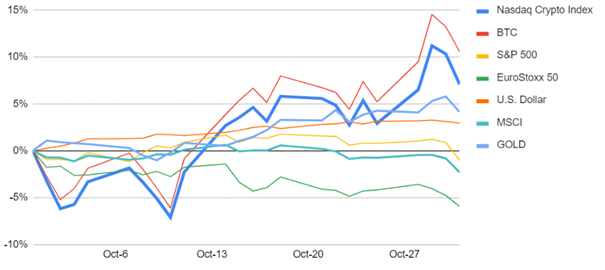
Nasdaq Crypto Index (NCI) relative to other asset class in October 24
Source: Hashdex, as of 30/10/24.
In comparison with traditional assets, the NCI’s 7.1% gain far outpaced the S&P 500 and Nasdaq 100, both of which posted slight declines. This performance underscores the potential for crypto assets to provide upside during periods of broader market uncertainty. The majority of this outperformance was driven by Bitcoin’s strength, underscoring its role as a cornerstone of the crypto asset class and its growing appeal as a macroeconomic hedge.
Performance attribution:
Nasdaq Crypto Index (NCI)
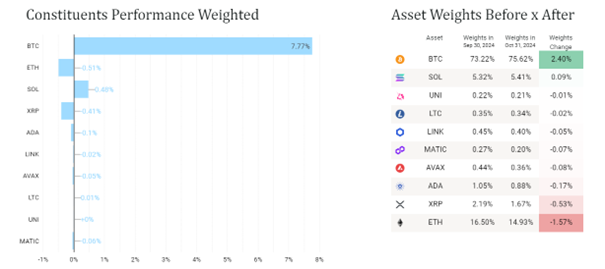
The NCI recorded positive returns for most of its primary constituents, with Bitcoin (+10.6%) leading the gains. Solana (SOL) also contributed positively, rising 9.0%. However, Ripple (XRP) and Polygon’s MATIC weighed on the index, with losses of 18.6% and over 20%, respectively. Ripple’s decline was largely attributed to ongoing legal issues with the SEC, while MATIC’s transition to the POL token created additional downward pressure.
Source: Hashdex, as of 31/10/24.
Crypto Momentum Factor Index
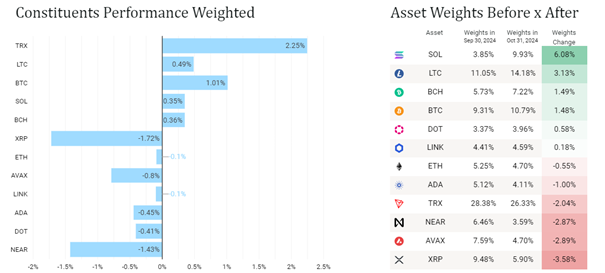
The Crypto Momentum Factor Index showed a slight monthly decline of 0.5% in October, reflecting the underperformance of altcoins in general. Although Tron (TRX) remained relatively stable, other altcoins in the index faced headwinds, leading to a small monthly loss for the index.
Source: Hashdex, as of 31/10/24.
Correlation (3m) to traditional asset classes
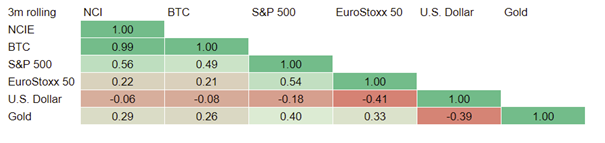
Source: Hashdex, as of 31/10/24. NCI for Nasdaq Crypto Index.
Hashdex Nasdaq Crypto Index ETP
Largest Crypto Index ETP in Europe, AUM ~$400m
ISIN: CH1184151731 / Tickers: HASH (SIX and Euronext) or HDX1 (Xetra) – tradable in USD, EUR, CHF and GBP
Hashdex Crypto Momentum Factor ETP
ISIN: CH1218734544 / Tickers: HAMO (SIX and Euronext) or HDXM (Xetra) – tradable in USD, EUR, CHF and GBP












iShares Space Technologies UCITS ETF investera bortom jorden

JIPD ETF delar ut månadsvis

Quantum computers can’t break bitcoin. Yet.

MMAX ETF är en globalfond

SICE ETF köper investment grade företagsobligationer från hela världen

USA satsar 2 miljarder dollar på kvantdatorer – så kan investerare dra nytta av utvecklingen

De bästa ETFerna för att investera i emerging markets

Extrema skillnader: Varför presterar Europas kvantdator-ETFer så olika?

Fastställd utdelning i MONTDIV maj 2026

Varför Plus500 är en dröm för finans-affiliate
-
 Nyheter3 veckor sedan
USA satsar 2 miljarder dollar på kvantdatorer – så kan investerare dra nytta av utvecklingen
-
 Nyheter4 veckor sedan
De bästa ETFerna för att investera i emerging markets
-
 Nyheter2 veckor sedan
Extrema skillnader: Varför presterar Europas kvantdator-ETFer så olika?
-
 Nyheter3 veckor sedan
Fastställd utdelning i MONTDIV maj 2026
-
 Nyheter2 veckor sedan
Varför Plus500 är en dröm för finans-affiliate
-

 Nyheter4 veckor sedan
ASWF ETF är en aktivt förvaltad fond som investerar i Kanada
-

 Nyheter2 veckor sedan
ETFer för fotbolls-VM 2026
-

 Nyheter2 veckor sedan
QQCC ETF följer företag världen över som är aktiva inom kvantberäkning
