Följ oss

Nyheter

Mixed Macro Messages and Bitcoin’s Ongoing Battles

Publicerad

den

Ongoing Battles This week, all eyes are on the upcoming CPI and PPI data, crucial for gauging US inflation trends. A higher-than-expected reading would signal persistent inflation, likely leading the U.S. Federal Reserve to maintain its high interest rate regime. This outcome would naturally shift investor attention away from cryptoassets, as investors seek the relative safety of fixed-income assets, like U.S. Treasuries. That being said, U.S. inflation does appear to be on a downturn, with GDP decreasing to 1.4% in the first quarter of the year, a rapid deceleration from the end of last year. Growth slowing down is important for prices to be tamed. Last month’s PCE reading also came in at 2.6%, in line with expectations. Furthermore, the latest jobs report highlighted that the total number of Americans collecting unemployment benefits rose for the ninth straight week, reaching 1.86M, the highest level since November 2021! Coupled with unemployment rising to 4.1%, this indicates a labor market slowdown, which could ease inflationary pressures further.

This week, all eyes are on the upcoming CPI and PPI data, crucial for gauging US inflation trends. A higher-than-expected reading would signal persistent inflation, likely leading the U.S. Federal Reserve to maintain its high interest rate regime. This outcome would naturally shift investor attention away from cryptoassets, as investors seek the relative safety of fixed-income assets, like U.S. Treasuries. That being said, U.S. inflation does appear to be on a downturn, with GDP decreasing to 1.4% in the first quarter of the year, a rapid deceleration from the end of last year. Growth slowing down is important for prices to be tamed. Last month’s PCE reading also came in at 2.6%, in line with expectations. Furthermore, the latest jobs report highlighted that the total number of Americans collecting unemployment benefits rose for the ninth straight week, reaching 1.86M, the highest level since November 2021! Coupled with unemployment rising to 4.1%, this indicates a labor market slowdown, which could ease inflationary pressures further.

However, global liquidity is falling steeply as shown in Figure 1 below, evidenced by a 13% increase in U.S. repo volume in June. This indicates that financial institutions are turning to collateralized borrowing to secure short-term funds, signaling reduced cash availability and higher borrowing costs. Similarly, in Europe, the EU repo volume crossed over €300B, tightening liquidity conditions further. Less global liquidity means reduced cash flow into risk-on assets, potentially pressuring the crypto market despite dwindling inflationary pressures.

Figure 1 – EU and U.S. Central Bank Balance Sheet
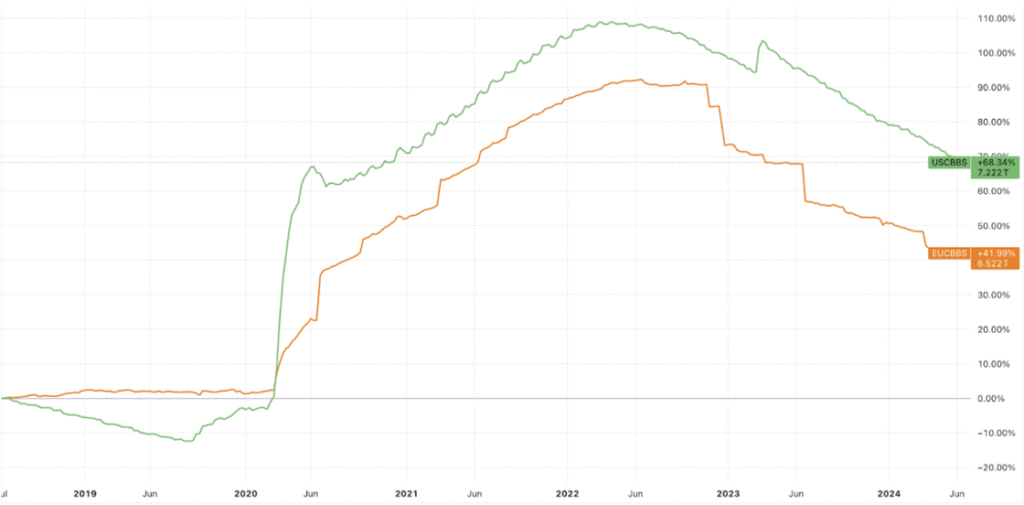
Source: TradingView

Looking within crypto, Bitcoin is currently facing a combination of industry-native factors that are contributing to the recent price decline. The German government has been consistently selling close to 1,000 BTC or almost $58M per day, over the last week, from their seized stash originating from the pirating website Movie2K. This ongoing selling pressure could continue for approximately two to three more weeks until the rest of their holdings standing at 26K BTC are liquidated. Additionally, the Mt. Gox repayment program has commenced, with nearly 47,000 BTC transferred to unidentified wallets that have not made any further moves yet. This indicates that this amount, equating to $2.7B worth of BTC, will be the first stack reimbursed back to creditors.

It’s worth highlighting though that creditors will receive their allocation over multiple days through different exchanges, which should somewhat mitigate the selling pressure. Tax considerations are also another reason why the selling is unlikely to materialize in a short timeframe given the price appreciation that BTC has undergone in the last decade since the exchange’s hack.

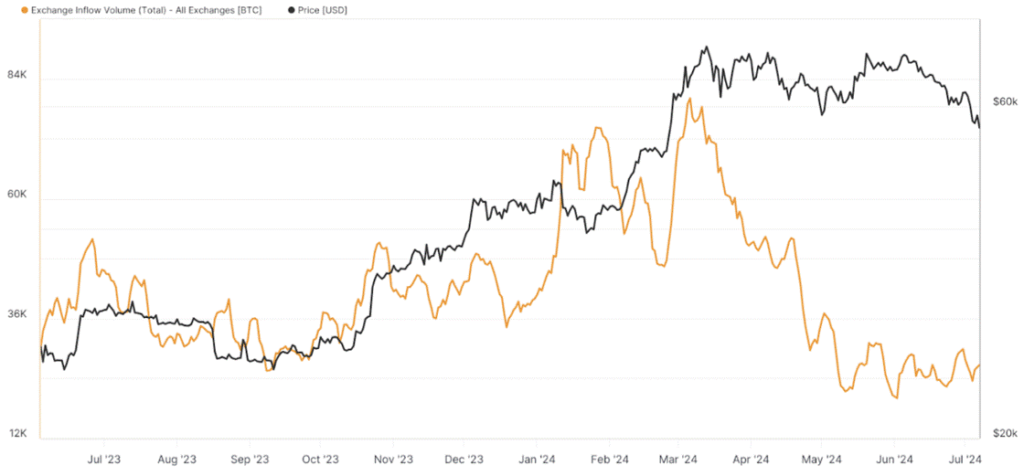
That said, Bitcoin’s liquidity appears sufficient to withstand potential selling pressure without significant market impact. Even on the slowest days, the average inflow to exchanges has been around an average of 20K BTC, as shown below in Figure 2. Additionally, it takes approximately 500 BTC on the most liquid exchange, Bitfinex, to cause a 2% drop in BTC price, and an average of 250 BTC on the next three most liquid platforms to produce a similar price movement. Therefore, a 10-15% drawdown seems plausible for the worst-case scenario of creditors selling all their holdings immediately, which we don’t believe will be the case. In addition, individual investors with large amounts could also sell over the counter (OTC) to get a better rate and avoid price slippage, which could further reduce the market impact of their BTC offloading.

Figure 2: Total transfer volume of BTC to exchanges
Source: Glassnode

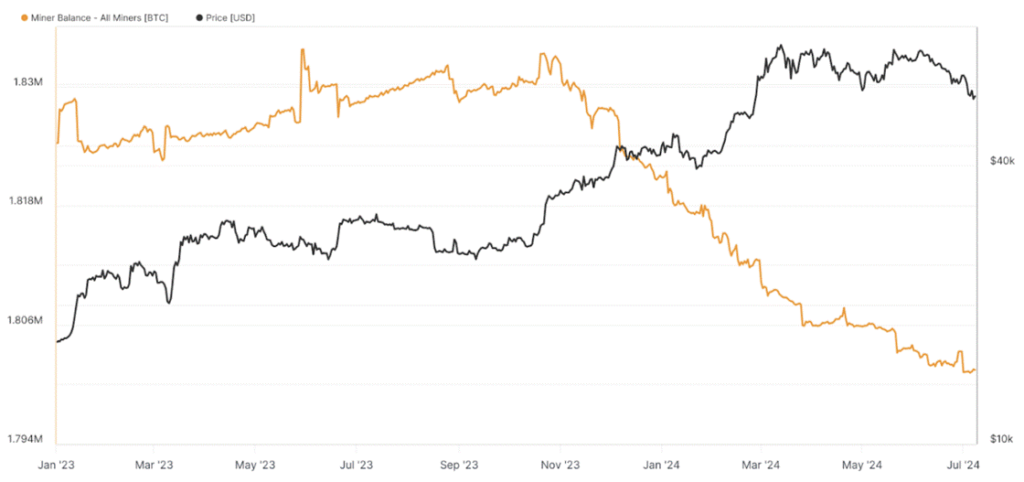
Another factor to consider is miners’ selling pressure. After disposing of nearly 30K BTC in June, miners have finally reduced their selling activity in the past two weeks. This marks their current reserves at around 1.9M BTC, seen below in Figure 3, the lowest point in the last 10 years. Finally, Bitcoin’s mining difficulty is set to decrease by 5%, marking the second largest drop since the FTX collapse. This reduction will benefit miners by enabling them to produce more Bitcoin with less effort, likely improving their profitability.

Figure 3: Bitcoin Miners Balance
Source: Glassnode

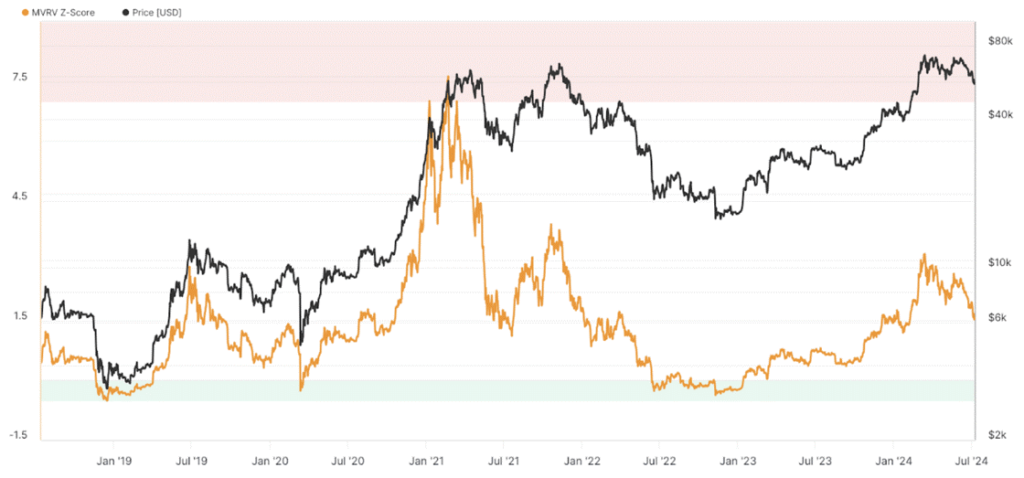
On another positive note, on-chain data shows that Long-term holders (LTHs) have stopped reducing their BTC supply since late June. This is a positive development, as LTHs maintaining a stable supply is crucial for Bitcoin to sustain its upward momentum. Similarly, Bitcoin’s MVRV ratio, which compares its current market price to its ”realized price” (the average price at which each coin was last moved), suggests that Bitcoin is currently trading at levels similar to June 2021 when it was around $30K. Notably, Bitcoin rebounded from the $30K price level to reach its all-time high later in 2021. This could be an encouraging sign of Bitcoin’s growth potential in terms of relative valuation during the current market cycle.

Figure 4: Bitcoin’s Market Value to Realized Value (MVRV)
Source: Glassnode

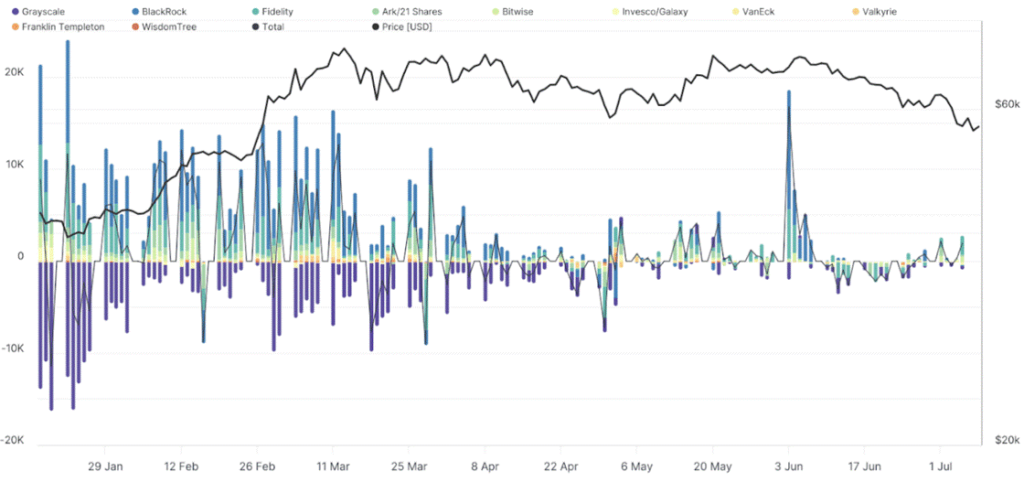
Altogether, there are potential catalysts that could turn the tide in the coming months. For instance, a resurgence in ETF inflows could offset the selling pressure precipitated by the influx of BTC entering the market. Notably, there were days in Q1 when the regulated vehicle absorbed more than 10K BTC, as depicted below in Figure 5. Further, the arrival of new market participants, such as registered investment advisors (RIAs) representing the wealthiest investors, could significantly alter the market’s supply and demand dynamics. In addition, the approval of Ethereum ETFs expected anytime within the next two weeks could also reignite interest in the market. Even if inflows are anticipated to be at best 25% of the $10B invested in Bitcoin’s ETFs in the first few months of the year. It’ll nevertheless catalyze broader interest in the market and can be expected to benefit tokens of the Ethereum ecosystem. Finally, election season is another catalyst for crypto. Particularly in the U.S., Bitcoin has become a polarizing campaigning tool for the Republicans as Trump led the way in advocating for the largest crypto asset by market cap. In fact, the Republican party has officially included the advocacy for BTC as part of their 2024 election campaign, which shows the growing influence of crypto within US politics.

Figure 5: US Spot ETF Inflows Denominated in BTC
Source: Glassnode

This Week’s Calendar
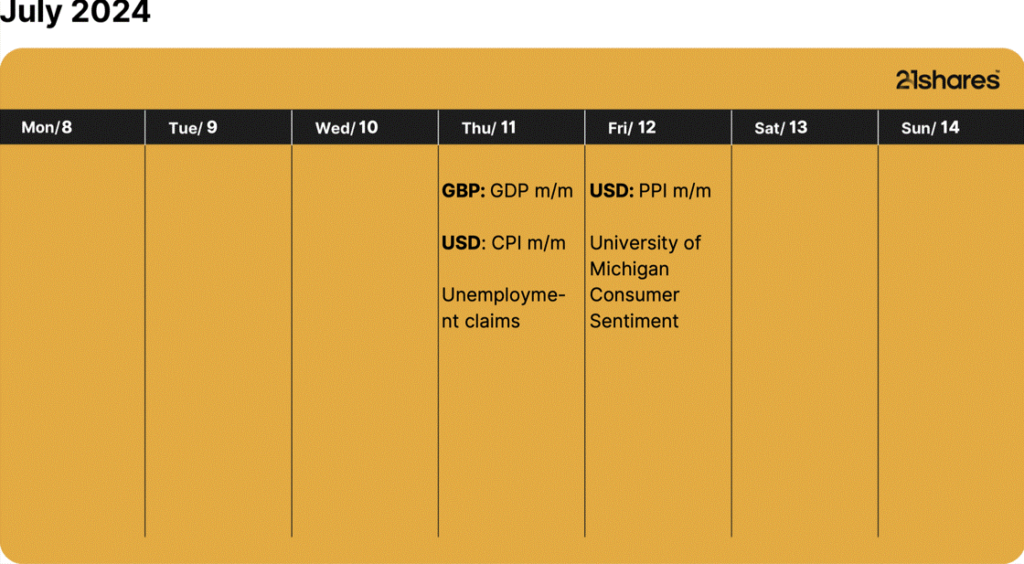
Source: Forex Factory, 21Shares

Research Newsletter

Each week the 21Shares Research team will publish our data-driven insights into the crypto asset world through this newsletter. Please direct any comments, questions, and words of feedback to research@21shares.com

Disclaimer

The information provided does not constitute a prospectus or other offering material and does not contain or constitute an offer to sell or a solicitation of any offer to buy securities in any jurisdiction. Some of the information published herein may contain forward-looking statements. Readers are cautioned that any such forward-looking statements are not guarantees of future performance and involve risks and uncertainties and that actual results may differ materially from those in the forward-looking statements as a result of various factors. The information contained herein may not be considered as economic, legal, tax or other advice and users are cautioned to base investment decisions or other decisions solely on the content hereof.


Fortsätt läsa
Annons
Klicka för att kommentera

Skriv en kommentar

Din e-postadress kommer inte publiceras. Obligatoriska fält är märkta *

Nyheter

Invesco: Gold signals a shifting world order without a new leader

Publicerad

den

The United States remains economically and financially dominant, but beneath the surface doubts are growing about how sustainable that position really is. According to Benjamin Jones, head of research at Invesco, the continued rise in gold suggests that investors are preparing for a world in which the balance of power is shifting, without any clear alternative leader emerging.

The United States remains economically and financially dominant, but beneath the surface doubts are growing about how sustainable that position really is. According to Benjamin Jones, head of research at Invesco, the continued rise in gold suggests that investors are preparing for a world in which the balance of power is shifting, without any clear alternative leader emerging.

The US twin deficits

The joint, pre-2025 rally in US risk assets and the dollar sits uneasily with concerns over US fiscal and current-account deficits, a deteriorating Net International Investment Position (NIIP), reindustrialisation goals, and the secular rise in gold, explains Jones.

“In our view, the long-running rally in gold alongside high returns and rising concentration in dollar assets reflects two forces: a faltering world order and the economics of heavy US fiscal imbalances, rising external obligations, and persistent deficits; but also, the unique success of US firms in driving GDP growth, earnings and innovation. Ironically, that strength may itself increase the risk of a financial, currency or balance-of-payments shock in a geopolitical crisis.”

According to Jones, the sharp drop in the US NIIP has come as foreign claims outstrip US claims abroad. “This was driven less by foreign Treasury holdings, which have stabilised, and more by inflows into private-sector assets, especially equities, as investors embraced “US Exceptionalism” as shorthand for superior growth and financial performance relative to peers such as Western Europe and Japan. The result has been major inflows into US equities, corporate debt and private markets.”

Even though much of the increase in exposure has been to risk assets rather than bonds, large outflows could still threaten fiscal and financial stability, says Jones. “For now, trade barriers and efforts to weaken the dollar to promote reindustrialisation have prompted rebalancing away from US stocks, bonds and the dollar. Amid geopolitical tensions, weaker fiscal and external positions, and renewed protectionism and unpredictability, official investors and private investors have sharply increased gold purchases as a store of value.”

Heavy gold flow in financial markets

US financial leadership persists despite geoeconomic rebalancing toward rivals, Jones continues. “The US still leads in market capitalisation, turnover and liquidity, while the Treasury market remains the largest and deepest pool of debt issuance. Dollar liquidity is so high that trades <<between other currencies are often executed through the dollar. Global portfolio concentration in the US has also been reinforced by inflows into benchmarked funds and passive trackers. The core driver remains US exceptionalism. Rich valuations and concentration in US tech may suggest a bubble, yet US firms have continued to deliver innovation, market share, revenue and earnings growth.”

According to Jones, rivals remain less compelling from a market perspective. “Europe has lagged the US since the financial crisis, while China has matched or surpassed US innovation but, until recently, delivered weaker market returns due to domestic de-risking policies.”

The US share of official reserves has declined somewhat, while the euro and most other currencies have levelled off, Jones continues. “Gold’s share has risen sharply since the start of the war in Ukraine in 2022, suggesting the TINA problem persists: there is no real alternative to the dollar other than gold itself. Central banks increasingly prefer the safety of gold, the liability of no government.”

Future: Geopolitical, economic, technological and military competition
An open world economy helped many countries narrow productivity gaps with the US, but leadership is no longer aligned across power domains. “Economically, the world is increasingly tripolar, centred on the US, China and the eurozone. Militarily, power is concentrated in the US, China and Russia. Technologically, the US and China are at or near parity, while others lag. Financially, however, the US still has no peer,” notes Jones.

He continues: “Conventional economic, military and technological competition therefore still matters, even in a nuclear world. US concerns about overextension are sharpened by China’s vast industrial capacity, with output and shipbuilding far exceeding that of the US. Recent wars have shown that modern conflict still depends on industrial mobilisation for technology, drones and ammunition. This helps explain the US push for reindustrialisation.”

At the same time, US fiscal and external obligations create vulnerabilities if confidence were shaken by a future crisis, conflict or major shock. Jones concludes: “Washington is also retreating from parts of the multilateral order while seeking to reshape global trade more in its favour, reinforcing perceptions of unilateralism. Gold may be signaling an incomplete global reordering: not a clear new polarity, but an “unipolar” world in which leadership shifts by issue, region and moment. The US and the dollar would still likely remain first among equals, supported by deep financial markets, technological dynamism and strategic advantages, even as rival powers continue to rise.”

Fortsätt läsa

Nyheter

ASLT ETF företagsobligatoner med kort duration

Publicerad

den

AXA IM Short Duration Income UCITS ETF USD Dist (ASLT ETF) med ISIN IE000P0AMD16, är en aktivt förvaltad börshandlad fond.

AXA IM Short Duration Income UCITS ETF USD Dist (ASLT ETF) med ISIN IE000P0AMD16, är en aktivt förvaltad börshandlad fond.

ETFen investerar i företagsobligationer från hela världen. Rating: Investment grade. Löptid: 1–3 år.

Den börshandlade fondens totala kostnadskvot (TER) uppgår till 0,19 % per år. Ränteintäkterna (kuponger) i ETFen delas ut till investerarna (månadsvis).

AXA IM Short Duration Income UCITS ETF USD Dist är en mycket liten ETF med 0 miljoner euro förvaltade tillgångar. Denna ETF lanserades den 9 juli 2025 och har sitt säte i Irland.

Handla ASLT ETF

AXA IM Short Duration Income UCITS ETF USD Dist (ASLT ETF) är en europeisk börshandlad fond. Denna fond handlas på flera olika börser, till exempel Deutsche Boerse Xetra och Borsa Italiana.

Det betyder att det går att handla andelar i denna ETF genom de flesta svenska banker och Internetmäklare, till exempel  Nordnet, SAVR, DEGIRO och Avanza.

Börsnoteringar

BörsValutaKortnamn
Borsa ItalianaEURASLU
XETRAUSDASLU
XETRAEURASLT

Fortsätt läsa

Nyheter

Anslut dig till kvantrevolutionen med Lunates nya ETF på Xetra

Publicerad

den

Kvantdatorteknik transformerar alla sorters industrier från hälso- och sjukvård till cybersäkerhet, och Boreas kliver fram som en nyckelspelare. Lunate Capitals Boreas Solactive Quantum Computing UCITS ETF på Xetra erbjuder investerare en diversifierad exponering mot ledande globala kvantteknologibolag.

Kvantdatorteknik håller snabbt på att gå från forskningslabb till verkliga tillämpningar – och investerare får nu ett nytt sätt att ta del av utvecklingen. Med lanseringen av Boreas Solactive Quantum Computing UCITS ETF (QQCC) Xetra öppnas dörren till ett av de mest transformativa teknikområdena i modern tid.

En ny era inom datorkraft

Till skillnad från traditionella datorer, som bearbetar information steg för steg, kan kvantdatorer analysera många möjliga lösningar samtidigt. Resultatet är en exponentiell ökning i beräkningskraft – med potential att lösa problem som idag är praktiskt taget omöjliga.

Enligt uppskattningar kan kvantteknologi skapa upp till 2 biljoner (eng: trillions) dollar i ekonomiskt värde fram till 2035.

Tekniken väntas få särskilt stor påverkan inom områden som:

Läkemedelsutveckling – snabbare simulering av proteinveckning och sjukdomar

Materialvetenskap – utveckling av starkare och lättare material

Finans – förbättrad riskhantering och portföljoptimering

Stark tillväxt och ökade investeringar

Kvantindustrin befinner sig i ett tydligt tillväxtskede. Under 2024 investerades omkring 2 miljarder dollar i kvantstartups globalt, samtidigt som statliga satsningar överstiger 50 miljarder dollar totalt. Både USA och Kina har uttryckt kvantmekanik som särskilt viktigt och prioriterat område och stora satsningar har tillkännagivits under 2025 och 2026.

Samtidigt växer marknaden snabbt, med ökande patentaktivitet och stora samarbeten mellan teknikbolag och investerare. Regionen Mellanöstern, särskilt UAE och Saudiarabien, positionerar sig också som en viktig hub för kvantutveckling.

ETF ger bred exponering mot kvanttemat

Den nya ETF:en, Boreas Solactive Quantum Computing UCITS ETF (QQCC), är utformad för att ge investerare diversifierad exponering mot cirka 25 ledande bolag inom kvantteknologi.

Indexet omfattar hela värdekedjan, inklusive:

• Hårdvara för kvantdatorer

• Mjukvara och algoritmer

• Kvantkommunikation och cybersäkerhet

Portföljen kombinerar globala teknikledare med mycket forskning och utveckling inom kvantum såsom IBM och Google, med mer nischade, snabbväxande bolag som IonQ, Rigetti och D-Wave.

Skillnader mot andra liknande ETFer

I enlighet med Boreas devis om att vara ”true to theme” i sin ETF-design fokuserar fonden på att enbart inkludera de bolag som är absolut mest relevanta mot utvecklingen av framförallt Quantum Computing hårdvara så som mikrochip (QPU’s). Portföljen är framtagen med hjälp av Solactives natural language processing verktyg ARTIS och vikterna i portföljen är enligt varje bolags relevans mot temat.

Fonden rebalanseras två gånger om året vilket möjliggör att snabbt snappa upp nykomlingar och bolag som snabbt gör framsteg inom temat. Med hjälp av ARTIS-verktyget kan på så sätt relevanta bolag snabbt få ökad vikt och mindre framgångsrika bolag få mindre.

Andra liknande fonder fokuserar ofta på bolag med mest patent inom kvantum. Detta kan leda till att bolag som främst använder kvantum hamnar i de portföljerna, medans Boreas fond fokuserar på de bolag som leder utvecklingen inom kvantumteknologin. Många av bolagen konkurrerar om att bli ”nästa NVIDIA” och leda en ny generations mikrochip.

Med en total kostnad (TER) på 0,49 % erbjuder fonden ett konkurrenskraftigt sätt att få exponering mot ett komplext och snabbt utvecklande tema.

Ett tema för långsiktiga investerare

Kvantteknologi ses i allt större utsträckning som en strategisk nyckelindustri, inte minst i takt med diskussionen om “Q-Day” – den punkt då kvantdatorer kan bryta dagens krypteringssystem.

För investerare innebär detta både risker och möjligheter. Som tematisk investering är ETFen särskilt lämpad som ett komplement – en så kallad satellitallokering – till bredare aktieportföljer. Trots att forskningen inom kvantdatorer har pågått i över 45 år är det en teknologi i tidigt skede där en klar vinnare ännu inte korats. Det gör temat volatilt och extra känsligt för positiva såväl som negativa nyheter.

Slutsats

Med lanseringen på Xetra blir kvantinvesteringar nu mer tillgängliga för europeiska investerare. För den som vill positionera sig inför nästa stora teknologiska skifte erbjuder Boreas kvant-ETF en enkel väg in i ett område som kan definiera framtidens ekonomi.

Namn: Boreas Solactive Quantum Computing UCITS ETF USD (Acc)

Ticker: QQCC

Handelsplats: Xetra

Handla QQCC ETF

Boreas Solactive Quantum Computing UCITS ETF USD (Acc) (QQCC ETF) är en europeisk börshandlad fond. Denna fond handlas på flera olika börser, till exempel Deutsche Boerse Xetra.

Det betyder att det går att handla andelar i denna ETF genom de flesta svenska banker och Internetmäklare, till exempel  Nordnet, SAVR, DEGIRO och Avanza.

Fortsätt läsa

Prenumerera på nyheter om ETFer

* indicates required

Populära