Följ oss

Nyheter

Michael Saylor started it, but now everyone wants a slice of Bitcoin

Publicerad

den

Bitcoin advocate and Strategy’s founder, Michael Saylor, kicked off the trend of incorporating Bitcoin into the company's balance sheet back in 2020, and now, it’s catching fire. This year, alongside institutional adoption and the rise of nation-state involvement, corporate Bitcoin holdings have surged dramatically. Companies have invested an estimated $25 billion in Bitcoin in just the first five months of 2025. This influx accounts for about 1.20% of Bitcoin’s total fixed supply, underscoring a supply-demand imbalance that’s fueling Bitcoin’s growing appeal as a treasury asset.
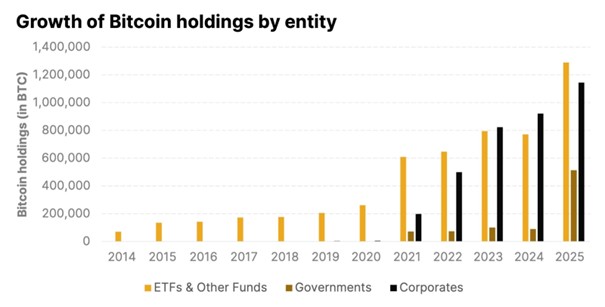
Bitcoin advocate and Strategy’s founder, Michael Saylor, kicked off the trend of incorporating Bitcoin into the company’s balance sheet back in 2020, and now, it’s catching fire. This year, alongside institutional adoption and the rise of nation-state involvement, corporate Bitcoin holdings have surged dramatically. Companies have invested an estimated $25 billion in Bitcoin in just the first five months of 2025. This influx accounts for about 1.20% of Bitcoin’s total fixed supply, underscoring a supply-demand imbalance that’s fueling Bitcoin’s growing appeal as a treasury asset.

Source: 21Shares, BitcoinTreasuries, Data as of January 1, 2025.

Which companies are betting on Bitcoin?

One prominent example of corporate Bitcoin adoption is GameStop, the American video game retailer, which recently raised $1.5 billion to build its Bitcoin reserve. Known for its role as a meme stock in early 2021, when retail investors on Reddit’s WallStreetBets forum triggered a massive short squeeze, GameStop survived the saga with spare capital. This resilience allowed the company to revamp its commercial strategy, positioning it to strategically deploy capital into Bitcoin and align with the growing trend of corporate crypto adoption.

Adding to this momentum, Strive Asset Management, backed by entrepreneur Vivek Ramaswamy, announced plans to go public via a reverse merger with Nasdaq-listed Asset Entities, aiming to become a publicly traded Bitcoin treasury company. Strive targets up to $1 billion in capital through equity and debt offerings to accelerate its Bitcoin accumulation, with plans for equity-for-Bitcoin swaps for accredited investors, offering a novel approach to scaling corporate Bitcoin exposure.

Another notable player is MetaPlanet in Japan, which has accumulated over $700 million in Bitcoin, reflecting the broadening international interest in Bitcoin as a treasury asset. Similarly, 21 Capital is poised to become the second-largest corporate holder with 42,000 Bitcoin, while in Europe, the Blockchain Group has set an ambitious target to acquire up to 260,000 Bitcoin by 2033, aiming for $20 billion in holdings.

Michael Saylor’s Strategy is leading the institutional charge and has established itself as the benchmark for corporate Bitcoin accumulation. As of May 2025, Strategy holds 555,450 Bitcoin, representing approximately 2.6% of Bitcoin’s total fixed supply, making it the largest public holder of Bitcoin globally. Year-to-date, the company has added 109,050 Bitcoin at an average purchase price of roughly $94,000, bringing the total market value of its Bitcoin position to approximately $55 billion.

How can Strategy’s Bitcoin balance sheet change market dynamics?

At the beginning of the year, Strategy held around 386,700 Bitcoin. Now, it has increased its holdings to over 550,000 Bitcoin. This imbalance underscores increasing structural pressure on Bitcoin’s supply. As a scarce and finite asset, such aggressive accumulation by a single entity signals potential supply-side constraints, particularly as more institutions seek long-term allocations.

Figure 2: The Effect of Strategy’s Acquisitions on Bitcoin’s Supply in 2025
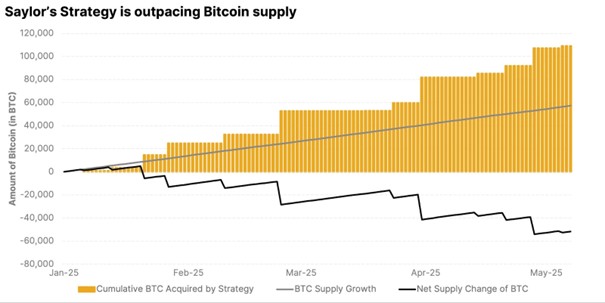
Source: 21Shares, BitcoinTreasuries, Data as of May 7, 2025.

Beyond the sheer size of Strategy’s Bitcoin treasury, its growth also speaks to the company’s consistency and discipline. Since August 2020, Strategy has steadily added to its holdings every quarter, signaling a long-term, methodical strategy rather than short-term opportunism.

Confident as ever, Strategy maintains that its outstanding convertible notes and preferred equity are significantly overcollateralized and is actively urging credit rating agencies to adopt a framework that recognizes Bitcoin as a viable, high-grade reserve asset. If realized, this framework could catalyze the development of a Bitcoin-native bond market, one in which corporations raise debt capital directly against Bitcoin reserves, while institutional investors gain exposure to a new, collateralized digital asset class.

More players join the Bitcoin club

Strategy’s proposal is rippling through the corporate world, hinting at the next phase of Bitcoin adoption: a Bitcoin-native financial market. Riot Capital and Coinbase have partnered to let companies use Bitcoin as collateral for working capital, turning idle reserves into active assets. Strike has rolled out Bitcoin-backed loans, while Europe’s Relai now lets users spend fiat without selling their Bitcoin. These early moves, echoing Strategy’s vision, mark a shift toward integrating Bitcoin directly into corporate finance, expanding its role as a macro asset, and attracting a new wave of institutional players.

By Maximiliaan Michielsen

Research Newsletter

Each week the 21Shares Research team will publish our data-driven insights into the crypto asset world through this newsletter. Please direct any comments, questions, and words of feedback to research@21shares.com

Disclaimer

The information provided does not constitute a prospectus or other offering material and does not contain or constitute an offer to sell or a solicitation of any offer to buy securities in any jurisdiction. Some of the information published herein may contain forward-looking statements. Readers are cautioned that any such forward-looking statements are not guarantees of future performance and involve risks and uncertainties and that actual results may differ materially from those in the forward-looking statements as a result of various factors. The information contained herein may not be considered as economic, legal, tax or other advice and users are cautioned to base investment decisions or other decisions solely on the content hereof.


Fortsätt läsa
Annons
Klicka för att kommentera

Skriv en kommentar

Din e-postadress kommer inte publiceras. Obligatoriska fält är märkta *

Nyheter

Invesco: Gold signals a shifting world order without a new leader

Publicerad

den

The United States remains economically and financially dominant, but beneath the surface doubts are growing about how sustainable that position really is. According to Benjamin Jones, head of research at Invesco, the continued rise in gold suggests that investors are preparing for a world in which the balance of power is shifting, without any clear alternative leader emerging.

The United States remains economically and financially dominant, but beneath the surface doubts are growing about how sustainable that position really is. According to Benjamin Jones, head of research at Invesco, the continued rise in gold suggests that investors are preparing for a world in which the balance of power is shifting, without any clear alternative leader emerging.

The US twin deficits

The joint, pre-2025 rally in US risk assets and the dollar sits uneasily with concerns over US fiscal and current-account deficits, a deteriorating Net International Investment Position (NIIP), reindustrialisation goals, and the secular rise in gold, explains Jones.

“In our view, the long-running rally in gold alongside high returns and rising concentration in dollar assets reflects two forces: a faltering world order and the economics of heavy US fiscal imbalances, rising external obligations, and persistent deficits; but also, the unique success of US firms in driving GDP growth, earnings and innovation. Ironically, that strength may itself increase the risk of a financial, currency or balance-of-payments shock in a geopolitical crisis.”

According to Jones, the sharp drop in the US NIIP has come as foreign claims outstrip US claims abroad. “This was driven less by foreign Treasury holdings, which have stabilised, and more by inflows into private-sector assets, especially equities, as investors embraced “US Exceptionalism” as shorthand for superior growth and financial performance relative to peers such as Western Europe and Japan. The result has been major inflows into US equities, corporate debt and private markets.”

Even though much of the increase in exposure has been to risk assets rather than bonds, large outflows could still threaten fiscal and financial stability, says Jones. “For now, trade barriers and efforts to weaken the dollar to promote reindustrialisation have prompted rebalancing away from US stocks, bonds and the dollar. Amid geopolitical tensions, weaker fiscal and external positions, and renewed protectionism and unpredictability, official investors and private investors have sharply increased gold purchases as a store of value.”

Heavy gold flow in financial markets

US financial leadership persists despite geoeconomic rebalancing toward rivals, Jones continues. “The US still leads in market capitalisation, turnover and liquidity, while the Treasury market remains the largest and deepest pool of debt issuance. Dollar liquidity is so high that trades <<between other currencies are often executed through the dollar. Global portfolio concentration in the US has also been reinforced by inflows into benchmarked funds and passive trackers. The core driver remains US exceptionalism. Rich valuations and concentration in US tech may suggest a bubble, yet US firms have continued to deliver innovation, market share, revenue and earnings growth.”

According to Jones, rivals remain less compelling from a market perspective. “Europe has lagged the US since the financial crisis, while China has matched or surpassed US innovation but, until recently, delivered weaker market returns due to domestic de-risking policies.”

The US share of official reserves has declined somewhat, while the euro and most other currencies have levelled off, Jones continues. “Gold’s share has risen sharply since the start of the war in Ukraine in 2022, suggesting the TINA problem persists: there is no real alternative to the dollar other than gold itself. Central banks increasingly prefer the safety of gold, the liability of no government.”

Future: Geopolitical, economic, technological and military competition
An open world economy helped many countries narrow productivity gaps with the US, but leadership is no longer aligned across power domains. “Economically, the world is increasingly tripolar, centred on the US, China and the eurozone. Militarily, power is concentrated in the US, China and Russia. Technologically, the US and China are at or near parity, while others lag. Financially, however, the US still has no peer,” notes Jones.

He continues: “Conventional economic, military and technological competition therefore still matters, even in a nuclear world. US concerns about overextension are sharpened by China’s vast industrial capacity, with output and shipbuilding far exceeding that of the US. Recent wars have shown that modern conflict still depends on industrial mobilisation for technology, drones and ammunition. This helps explain the US push for reindustrialisation.”

At the same time, US fiscal and external obligations create vulnerabilities if confidence were shaken by a future crisis, conflict or major shock. Jones concludes: “Washington is also retreating from parts of the multilateral order while seeking to reshape global trade more in its favour, reinforcing perceptions of unilateralism. Gold may be signaling an incomplete global reordering: not a clear new polarity, but an “unipolar” world in which leadership shifts by issue, region and moment. The US and the dollar would still likely remain first among equals, supported by deep financial markets, technological dynamism and strategic advantages, even as rival powers continue to rise.”

Fortsätt läsa

Nyheter

ASLT ETF företagsobligatoner med kort duration

Publicerad

den

AXA IM Short Duration Income UCITS ETF USD Dist (ASLT ETF) med ISIN IE000P0AMD16, är en aktivt förvaltad börshandlad fond.

AXA IM Short Duration Income UCITS ETF USD Dist (ASLT ETF) med ISIN IE000P0AMD16, är en aktivt förvaltad börshandlad fond.

ETFen investerar i företagsobligationer från hela världen. Rating: Investment grade. Löptid: 1–3 år.

Den börshandlade fondens totala kostnadskvot (TER) uppgår till 0,19 % per år. Ränteintäkterna (kuponger) i ETFen delas ut till investerarna (månadsvis).

AXA IM Short Duration Income UCITS ETF USD Dist är en mycket liten ETF med 0 miljoner euro förvaltade tillgångar. Denna ETF lanserades den 9 juli 2025 och har sitt säte i Irland.

Handla ASLT ETF

AXA IM Short Duration Income UCITS ETF USD Dist (ASLT ETF) är en europeisk börshandlad fond. Denna fond handlas på flera olika börser, till exempel Deutsche Boerse Xetra och Borsa Italiana.

Det betyder att det går att handla andelar i denna ETF genom de flesta svenska banker och Internetmäklare, till exempel  Nordnet, SAVR, DEGIRO och Avanza.

Börsnoteringar

BörsValutaKortnamn
Borsa ItalianaEURASLU
XETRAUSDASLU
XETRAEURASLT

Fortsätt läsa

Nyheter

Anslut dig till kvantrevolutionen med Lunates nya ETF på Xetra

Publicerad

den

Kvantdatorteknik transformerar alla sorters industrier från hälso- och sjukvård till cybersäkerhet, och Boreas kliver fram som en nyckelspelare. Lunate Capitals Boreas Solactive Quantum Computing UCITS ETF på Xetra erbjuder investerare en diversifierad exponering mot ledande globala kvantteknologibolag.

Kvantdatorteknik håller snabbt på att gå från forskningslabb till verkliga tillämpningar – och investerare får nu ett nytt sätt att ta del av utvecklingen. Med lanseringen av Boreas Solactive Quantum Computing UCITS ETF (QQCC) Xetra öppnas dörren till ett av de mest transformativa teknikområdena i modern tid.

En ny era inom datorkraft

Till skillnad från traditionella datorer, som bearbetar information steg för steg, kan kvantdatorer analysera många möjliga lösningar samtidigt. Resultatet är en exponentiell ökning i beräkningskraft – med potential att lösa problem som idag är praktiskt taget omöjliga.

Enligt uppskattningar kan kvantteknologi skapa upp till 2 biljoner (eng: trillions) dollar i ekonomiskt värde fram till 2035.

Tekniken väntas få särskilt stor påverkan inom områden som:

Läkemedelsutveckling – snabbare simulering av proteinveckning och sjukdomar

Materialvetenskap – utveckling av starkare och lättare material

Finans – förbättrad riskhantering och portföljoptimering

Stark tillväxt och ökade investeringar

Kvantindustrin befinner sig i ett tydligt tillväxtskede. Under 2024 investerades omkring 2 miljarder dollar i kvantstartups globalt, samtidigt som statliga satsningar överstiger 50 miljarder dollar totalt. Både USA och Kina har uttryckt kvantmekanik som särskilt viktigt och prioriterat område och stora satsningar har tillkännagivits under 2025 och 2026.

Samtidigt växer marknaden snabbt, med ökande patentaktivitet och stora samarbeten mellan teknikbolag och investerare. Regionen Mellanöstern, särskilt UAE och Saudiarabien, positionerar sig också som en viktig hub för kvantutveckling.

ETF ger bred exponering mot kvanttemat

Den nya ETF:en, Boreas Solactive Quantum Computing UCITS ETF (QQCC), är utformad för att ge investerare diversifierad exponering mot cirka 25 ledande bolag inom kvantteknologi.

Indexet omfattar hela värdekedjan, inklusive:

• Hårdvara för kvantdatorer

• Mjukvara och algoritmer

• Kvantkommunikation och cybersäkerhet

Portföljen kombinerar globala teknikledare med mycket forskning och utveckling inom kvantum såsom IBM och Google, med mer nischade, snabbväxande bolag som IonQ, Rigetti och D-Wave.

Skillnader mot andra liknande ETFer

I enlighet med Boreas devis om att vara ”true to theme” i sin ETF-design fokuserar fonden på att enbart inkludera de bolag som är absolut mest relevanta mot utvecklingen av framförallt Quantum Computing hårdvara så som mikrochip (QPU’s). Portföljen är framtagen med hjälp av Solactives natural language processing verktyg ARTIS och vikterna i portföljen är enligt varje bolags relevans mot temat.

Fonden rebalanseras två gånger om året vilket möjliggör att snabbt snappa upp nykomlingar och bolag som snabbt gör framsteg inom temat. Med hjälp av ARTIS-verktyget kan på så sätt relevanta bolag snabbt få ökad vikt och mindre framgångsrika bolag få mindre.

Andra liknande fonder fokuserar ofta på bolag med mest patent inom kvantum. Detta kan leda till att bolag som främst använder kvantum hamnar i de portföljerna, medans Boreas fond fokuserar på de bolag som leder utvecklingen inom kvantumteknologin. Många av bolagen konkurrerar om att bli ”nästa NVIDIA” och leda en ny generations mikrochip.

Med en total kostnad (TER) på 0,49 % erbjuder fonden ett konkurrenskraftigt sätt att få exponering mot ett komplext och snabbt utvecklande tema.

Ett tema för långsiktiga investerare

Kvantteknologi ses i allt större utsträckning som en strategisk nyckelindustri, inte minst i takt med diskussionen om “Q-Day” – den punkt då kvantdatorer kan bryta dagens krypteringssystem.

För investerare innebär detta både risker och möjligheter. Som tematisk investering är ETFen särskilt lämpad som ett komplement – en så kallad satellitallokering – till bredare aktieportföljer. Trots att forskningen inom kvantdatorer har pågått i över 45 år är det en teknologi i tidigt skede där en klar vinnare ännu inte korats. Det gör temat volatilt och extra känsligt för positiva såväl som negativa nyheter.

Slutsats

Med lanseringen på Xetra blir kvantinvesteringar nu mer tillgängliga för europeiska investerare. För den som vill positionera sig inför nästa stora teknologiska skifte erbjuder Boreas kvant-ETF en enkel väg in i ett område som kan definiera framtidens ekonomi.

Namn: Boreas Solactive Quantum Computing UCITS ETF USD (Acc)

Ticker: QQCC

Handelsplats: Xetra

Handla QQCC ETF

Boreas Solactive Quantum Computing UCITS ETF USD (Acc) (QQCC ETF) är en europeisk börshandlad fond. Denna fond handlas på flera olika börser, till exempel Deutsche Boerse Xetra.

Det betyder att det går att handla andelar i denna ETF genom de flesta svenska banker och Internetmäklare, till exempel  Nordnet, SAVR, DEGIRO och Avanza.

Fortsätt läsa

Prenumerera på nyheter om ETFer

* indicates required

Populära