Nyheter
Cash-Secured Put Options Explained: A Simple Guide

The cash-secured put strategy involves selling put options with the aim of generating income. But it may also appeal to investors looking to potentially buy stocks at an effective discount. In this guide, we’ll explain how cash-secured put options work – using the Nasdaq 100 as an example.
What is a cash-secured put?
A cash-secured put is a defensive options strategy that can generate income. In this strategy, you sell a put option on a stock (or another underlying investment). In return, you receive a premium upfront – which you keep as income unless the option is bought back or adjusted during the holding period.
Puts give the option buyer the right to sell the stock at a fixed price (the “strike price”). If the stock falls below that strike price, the buyer may choose to exercise the option and sell it to you.
As the seller of the option, you must be ready to buy the stock at that price. That’s where the “cash-secured” part comes in – you set aside enough cash to do so if required.
The premium you collect may help reduce your effective purchase cost. That’s why this strategy may appeal to investors who want to earn income – while also being happy to own the stock at a lower price if it drops.
Example: Cash-secured put on the Nasdaq 100
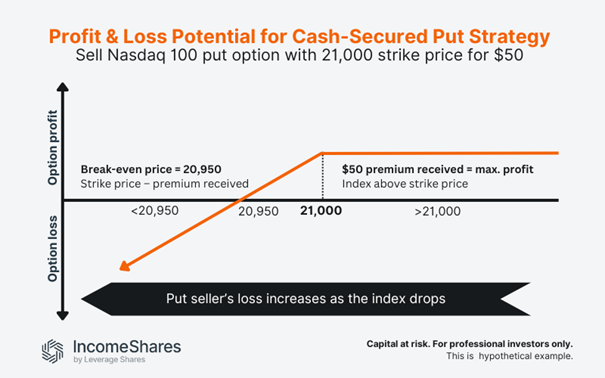
Suppose the Nasdaq 100 index is trading at 21,500. As part of a cash-secured put strategy, you sell a put option with a strike price of 21,000 and receive a $50 premium per contract. Here’s how it could play out:
Scenario 1: The Nasdaq 100 stays above the 21,000 strike price. The option expires worthless, since the buyer has no reason to use it. You keep the $50 premium as income, and your cash stays where it is.
Scenario 2: The Nasdaq 100 drops below the 21,000 strike price. The option buyer uses the put option, so you’re required to buy the Nasdaq 100 at the strike price of 21,000. But you already collected $50, so your net cost is 20,950 (21,000 strike minus 50 premium).
Scenario 3: The Nasdaq 100 falls sharply – say, to 19,000. You still have to buy at 21,000. The $50 premium lowers your cost slightly, but your effective purchase price (20,950) is still much higher than the current market level (19,000). You’d be sitting on a large unrealised loss.

How IncomeShares products use cash-secured puts
IncomeShares currently uses the cash-secured put strategy in two of its index-based income exchange-traded products (ETPs):
• Nasdaq 100 Options (0DTE) ETP
These ETPs sell ultra-short-term put options on the underlying indexes or ETFs that track them. The options expire the same day they’re written – a structure known as 0DTE (zero days to expiration).
Because they expire so quickly, 0DTE options tend to lose value fast – a dynamic known as time decay. It means the ETPs may often buy back the options later in the day for less than they sold them for in the morning. The difference is income.
By repeating this process each day – while setting aside enough cash to cover any options that may get exercised – the ETPs aim to generate regular income while managing downside risk.
Key takeaways
• A cash-secured put strategy involves selling a put option and holding enough cash in case you’re required to buy the underlying asset.
• It may appeal to investors seeking income – or for opportunities to buy stocks at a lower effective price.
• IncomeShares uses this strategy in its S&P 500 and Nasdaq 100 options ETPs. These sell 0DTE put options daily to potentially generate income while managing downside risk.
Follow IncomeShares EU for more insights.
Your capital is at risk if you invest. You could lose all your investment. Please see the full risk warning here.